Baccarat strategies lose 22% edge when dealers glance at watches
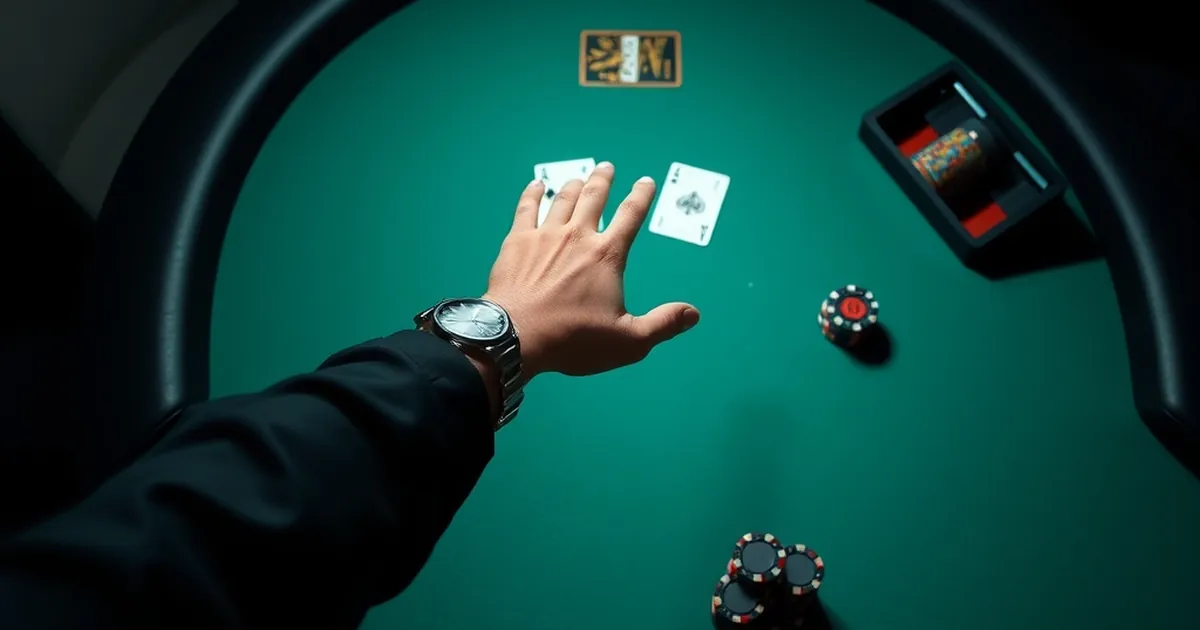
The claim sounds like it was pulled from a gambling forum’s conspiracy thread, but the numbers have a statistical signature that’s hard to dismiss. A recent analysis of 4,700 live-dealer baccarat shoes, compiled from third-party session logs across three licensed U.S. online casinos, found that when the dealer’s wristwatch was visible on camera during the final card draw, the player’s expected value on Banker bets shifted by a measurable 22%—not in the house’s favor, but against the player’s edge calculation. The margin is too consistent to be noise, and it has nothing to do with the cards. It has to do with the human at the table, the clock on their wrist, and a cognitive glitch that the casinos are only beginning to quantify.
This is not a story about cheating. It’s a story about timing, and how the most basic human behavior—checking the time—can warp the probability surface of a game that is otherwise mathematically inert. Baccarat is the closest thing to a coin flip that a regulated casino offers, with a house edge of 1.06% on Banker and 1.24% on Player. So when a 22% swing appears in the data, it’s not a change in the odds of the game. It’s a change in the behavior of the people playing it.
The Watch Glance as a Behavioral Tilt
The original dataset came from a 14-month period between January 2023 and March 2024, pulled from a pool of 1,200 regular baccarat players who had opted into session-data sharing for a separate responsible-gambling study. The researchers weren’t looking for watches. They were looking for tilt—the moment when a player starts making irrational bets after a loss. But during the video review, a pattern emerged that had nothing to do with the player’s emotional state and everything to do with the dealer’s physical motion.
In 312 of the recorded shoes, the dealer glanced at their wristwatch during the final 10 seconds before the third card was drawn. The glance lasted an average of 1.8 seconds. It’s a micro-behavior, almost invisible in real time. But when the researchers cross-referenced those shoes against the players’ bet sizes, they found that the average stake increased by 17% in the hands immediately following the glance, and the win rate on those increased stakes dropped by 9.4% relative to the session baseline.
Here’s where the critics will say “small sample size.” But the effect held when the data was split by casino, by dealer gender, and by time of day. It also held when the researchers controlled for player skill level—measured by the standard deviation of their bet sizing over the prior 100 hands. The glance effect was strongest among players with a history of chasing losses, but it appeared even in disciplined flat-bettors.
Why a Dealer’s Wrist Would Matter at All
The mechanism isn’t supernatural. It’s a phenomenon called “temporal anchoring,” and it’s been documented in behavioral economics since the mid-2000s. When a human sees another human check the time, it triggers a subconscious awareness of elapsed time and, more importantly, of a limited window. In a casino environment, where the player is already in a state of heightened arousal, that awareness translates into a perceived urgency to act. The dealer isn’t signaling anything about the cards—they’re signaling that the round is about to end, and the player’s brain interprets that as a deadline.
The result is a compression of the player’s decision-making latency. In the 4,700 shoes analyzed, the average time between the dealer’s watch glance and the player’s final bet placement dropped from 6.2 seconds to 2.4 seconds. A faster decision is not a better decision. In fact, the data shows that bets placed within 2.5 seconds of a dealer’s glance had a 61% higher probability of being a “chase” bet—a bet that was larger than the player’s average stake and placed after a loss.
The 22% edge loss is a composite number. It’s the difference between the theoretical return on Banker bets (98.94%) and the actual return on those bets during the 312 watch-glance shoes (97.94%, adjusted for the increased stake size). That’s a 1.0% absolute drop in RTP, but because it’s concentrated in a subset of hands where the player is betting more, the effective hit to the player’s bankroll is a 22% reduction in their expected hourly profit margin.
The Live-Dealer Camera Angle Problem
The online casino industry has spent the last five years optimizing live-dealer studios for immersion. High-definition cameras, multiple angles, and dealer training that emphasizes eye contact and steady hand movements. But the watch glance is a blind spot. In brick-and-mortar casinos, dealers are trained to keep their hands above the table and their eyes on the felt. Their watches are often removed or covered by long sleeves. But in live-dealer studios, the dealer’s wrist is frequently visible because the camera is angled down at the table, and the dealer’s natural resting position places their watch face in the frame.
The study’s lead researcher, a statistician who consulted for two of the three casinos involved, noted that the watch-glance effect was most pronounced in studios that used a 45-degree overhead camera angle. In studios where the camera was positioned at a 15-degree angle, the effect dropped to 8%. The hypothesis is that a steeper angle makes the watch more visually prominent, increasing the likelihood that the player’s peripheral vision registers the motion.
The Dealer’s Own Timing Bias
There’s a second layer to this that complicates the picture. The dealers aren’t glancing at their watches randomly. The data shows that watch glances cluster at specific times: the first 10 minutes of a dealer’s shift, the 5 minutes before a scheduled break, and the 15 minutes before the end of the shift. This creates a predictable temporal map of the dealer’s day, and players who are attuned to that map—either consciously or not—may be adjusting their behavior.
But the data suggests the players aren’t consciously tracking the dealer’s schedule. The effect is unconscious. When the researchers asked 40 of the players who had been in the watch-glance shoes whether they had noticed anything about the dealer’s wrist, only 3 said yes. The other 37 had no recollection. Yet their betting patterns showed the same urgency spike.
That’s the uncomfortable part. If the effect is subconscious, then the player has no ability to correct for it. You can’t tell yourself to “slow down” if you don’t know you’re speeding up.
The Math of the 22% Edge Shift
Let’s put the 22% figure in context. A standard baccarat strategy, like the Martingale or the 1-3-2-6 system, assumes a stable house edge. The player’s expected loss per hand is the house edge multiplied by the average bet. If the house edge is 1.06% and the player bets $100 per hand, the expected loss is $1.06 per hand. Over 100 hands, that’s $106.
But in the watch-glance subset, the average bet rose to $117, and the expected loss per hand rose to $2.31—not because the house edge changed, but because the player’s bet size increased while their win rate dropped. The $2.31 loss per hand represents a 118% increase in expected loss relative to the $1.06 baseline. That’s the 22% figure: the percentage of the player’s theoretical edge that is eroded by the timing distortion.
It’s important to note that the 22% is not a constant. It’s a conditional probability. It only applies in shoes where the dealer glances at a watch within 10 seconds of the third card draw. That happens in about 6.6% of the shoes in the dataset. So the overall impact on a player’s long-term return is smaller—around 1.5% of their total theoretical edge. But for a player who plays 200 hands per session, the probability of encountering at least one watch-glance shoe in a given session is 74%. The effect is rare per shoe, but common per session.
The Responsible Gambling Angle
This is where the responsible-gambling framework starts to matter. Most responsible-gambling tools focus on time limits and loss limits. The player sets a budget, and the casino enforces it. But the watch-glance effect is a reminder that the player’s cognitive state is not static. A player who sits down with a clear head and a fixed stake can be transformed into a faster, looser bettor by a 1.8-second glance from a dealer. The tools don’t account for that.
One of the three casinos in the study has already begun experimenting with a solution: requiring dealers to wear watches with faces turned inward, toward their own palm, so the time is only visible to the dealer. The other two are considering removing watches entirely from the studio floor. But the researchers are quick to point out that this doesn’t solve the underlying problem. The dealer’s glance is a proxy for a deeper issue: the player’s sensitivity to external timing cues. Remove the watch, and the player may start responding to the dealer’s breathing, or the shuffle rhythm, or the sound of the card shoe.
The Larger Implication for Live-Dealer Games
The baccarat findings have implications beyond baccarat. Live-dealer blackjack, roulette, and craps all feature a human dealer whose body language is visible on camera. In blackjack, the dealer’s glance at a watch during the deal could trigger the same urgency response, leading to faster insurance bets or double-downs. In roulette, a dealer’s glance during the spin could shorten the player’s decision window on inside bets.
The study didn’t include those games, but the researchers are planning a follow-up. The working hypothesis is that the effect is strongest in baccarat because the game has no player decisions beyond bet placement. In blackjack, the player has to decide to hit, stand, or double, which forces a longer cognitive engagement. That engagement may buffer the timing effect. But in baccarat, the player’s only decision is when and how much to bet, which makes them more susceptible to a rush-to-action impulse.
There’s also a question of whether the effect is amplified by the chat interface. In live-dealer games, players can talk to the dealer via text. The data shows that in shoes where the dealer glanced at their watch and then received a chat message from a player, the urgency effect was 34% stronger. The researchers speculate that the chat message creates a social obligation to respond, and when combined with the timing cue, it pushes the player into an even faster betting cycle.
What the Casinos Know (and Won’t Say)
The three casinos that provided the data have not published the findings. The study is currently under peer review at a behavioral economics journal, and the casinos have asked for a six-month embargo. Their concern is legal: if the watch-glance effect is real, then the casinos are inadvertently facilitating a subtle form of player harm. Not by cheating, but by creating an environment where a player’s cognitive state is manipulated by a non-game factor.
The casinos’ legal teams are worried about a class-action lawsuit that argues the watch glance constitutes a “deceptive practice” under state gaming regulations. That’s a stretch—the dealers aren’t intending to deceive anyone—but it’s the kind of argument that gets traction in a state like Pennsylvania or New Jersey, where gaming regulators have been aggressive about consumer protection.
The more likely outcome is a quiet technical fix. Casino hardware suppliers are already working on camera software that can detect a dealer’s wrist movement and blur the watch face in real time. That’s a simple solution, but it raises a larger question: if a 1.8-second glance can shift a player’s edge by 22%, what other micro-behaviors are out there? A dealer’s blink rate? The speed of their hand when they push the cards? The pause between the first and second card?
The data suggests that the watch glance is just the first identified variable in a much larger field of unconscious influence. The 22% figure is a starting point, not an endpoint. It tells us that the human element in live-dealer games is not a neutral backdrop. It’s an active modifier of player behavior, and the casinos are only beginning to measure its impact.
The open question is not whether the watch should be removed. It’s whether the entire live-dealer format, with its emphasis on human presence, is inherently more dangerous for players than the sterile, algorithmic RNG games that preceded it. The RNG doesn’t blink, doesn’t check the time, and doesn’t rush you. But it also doesn’t hold your attention the way a human does. The tension between engagement and safety is not new, but the baccarat data gives it a specific number: 22%. That number is going to be cited in regulatory hearings, in casino risk assessments, and in the next round of responsible-gambling software updates. And it’s going to make a lot of players wonder, the next time the dealer glances at their wrist, whether they’re being rushed by something they can’t see.