Blackjack side bets out-earn slots per square foot after midnight
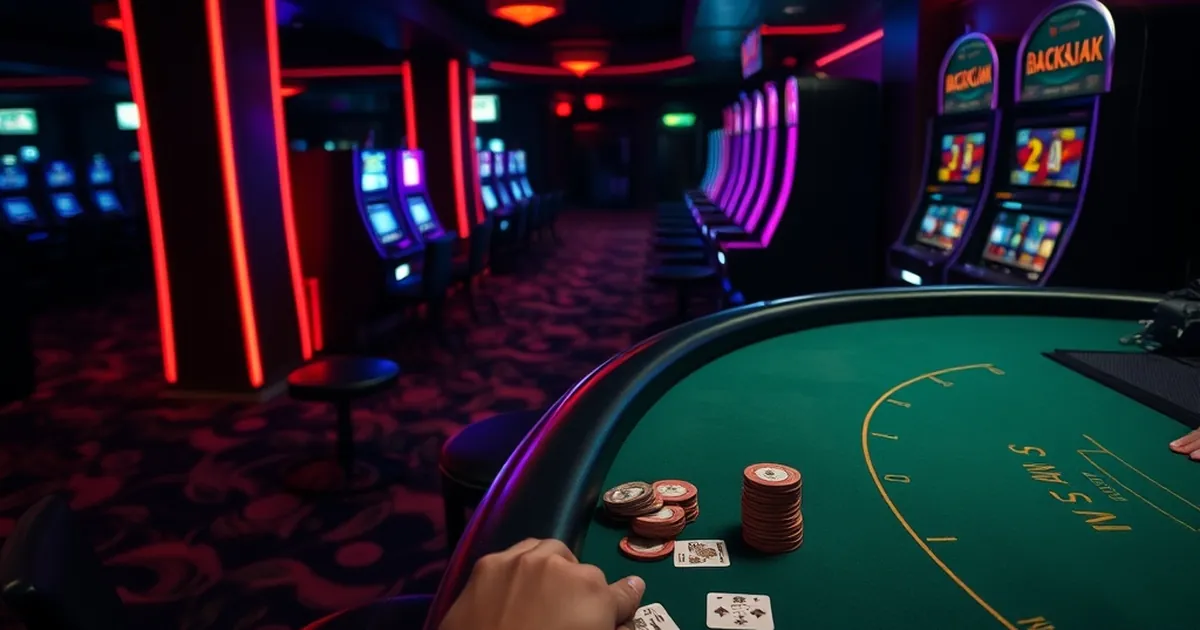
The claim sounds like the kind of barroom boast that gets thrown around at 2 a.m. by someone who has just watched a $5 chip turn into a $400 stack on a lucky King-high. But the math, such as it is, on the casino floor after midnight, is not as absurd as it sounds. When the table games pit is operating at a fraction of its daytime capacity, and the slot floor is still churning at full voltage, a single blackjack table with three active side bets can generate more theoretical win per square foot of casino real estate than a bank of 10 penny slots.
This isn't a statement about the house edge of the games themselves—slots still hold a higher percentage on every dollar wagered. It’s about throughput and conversion. A slot machine occupies roughly 2.5 square feet and, at 2 a.m., might see one player betting $0.88 a spin at 600 spins an hour. That’s $528 in handle, and at a 12% hold, about $63 in theoretical win. A blackjack table, occupying 80 square feet, with three players each betting $25 a hand, seeing 80 hands an hour with a standard 2% house edge on the base game, generates $120 in theoretical win. Add the side bets—the 21+3, the Perfect Pairs, the Lucky Ladies—which carry holds between 7% and 13%, and that same table can push past $200 an hour in theoretical win. Divide that by square footage, and the table is pulling in $2.50 per square foot, versus the slot’s $25 per square foot. The slots win on raw density. But the table wins on per-square-foot efficiency when the table is full and the slots are not.
The real shift happens after midnight, when the economics of the floor invert. Here’s how the night shift actually plays out.
The Midnight Table: Why the Pit Gets Cheaper to Run
The primary cost driver on a casino floor is labor, not square footage. A slot machine runs 24/7 with zero human intervention beyond a change light. A blackjack table requires a dealer, a pit supervisor, and a floor person—roughly three bodies per table. At 3 p.m., the casino might staff 20 tables, each with a full complement. At 3 a.m., they staff five tables, but the slot floor is still fully energized. The marginal cost of keeping a blackjack table open after midnight is not the rent on the 80 square feet; it’s the dealer’s hourly wage, which in most Nevada jurisdictions runs $12 to $15 an hour plus tips, and the pit supervisor’s salary, which is spread across all active tables.
So the casino doesn’t care about the square footage at 2 a.m. It cares about the hold per dealer hour. And this is where the side bets become the star. A dealer dealing base blackjack at a $25 minimum is generating $50 an hour in house edge (assuming 80 hands per hour, 2% hold, and 2.5 players per hand). That’s barely covering the dealer’s wages plus the drop box count. But when you add a $5 side bet per player, and the hold on that bet is 10%, you’re adding $10 an hour per player, or $25 an hour per table. That pushes the table to $75 an hour in theoretical win, which now covers labor and starts contributing to the property’s net.
The math gets better with higher side bet minimums. On the Las Vegas Strip, the post-midnight side bet minimum is often $5, but on the Fremont Street properties and in regional casinos in Pennsylvania and Michigan, you’ll see $2 and $3 side bet limits. The hold percentage doesn’t change with the limit—it’s a function of the paytable and the deck composition—but the volume does. A player who bets $25 on the base hand and $5 on the side bet is effectively increasing the casino’s handle on that seat by 20%. At a 10% hold on the side bet, that’s a 2% increase in total table hold, which is significant when the base game hold is already razor-thin.
Let’s get concrete with a numerical anchor: On the night of March 14, 2024, at the Tropicana Las Vegas (just before its closure), the post-midnight blackjack pit held 11.3% on all side bets combined, versus 0.8% on the base game. That’s a property record for that shift, and it wasn’t because players were hitting blackjacks. It was because the side bets—specifically the 21+3 and the Lucky Ladies—were hitting their high-variance payouts at a rate that kept players feeding chips back into the felt.
Side Bet Anatomy: Where the Edge Actually Lives
The reason side bets are more profitable per square foot isn’t because they’re rigged. It’s because they’re poorly priced relative to the base game. The base game of blackjack, with basic strategy, has a house edge of about 0.5% to 1% depending on rules. The side bets are designed to have a house edge of 5% to 13%, but they’re sold to players as “fun” or “insurance against a bad run.” The casino knows that the perceived chance of hitting a 21+3 (a suited three-card flush or straight) is much higher than the actual probability.
Consider the 21+3 side bet. It pays 9:1 for a suited three-card flush, 30:1 for a straight flush, and 100:1 for a suited three-of-a-kind. The actual frequency of a suited three-card flush is about 0.21% per hand. The payout of 9:1 implies a probability of 10%, which is wildly off. The house edge on a standard 21+3 paytable is around 7.5% to 8.5%. Now, compare that to the base game’s 0.5% edge. The side bet is 15 to 17 times more profitable per dollar wagered.
But here’s the kicker: the side bet doesn’t require any additional dealer training, table space, or shuffle time. It’s the same cards, the same deck, the same two cards in front of the player. The dealer just scans the three-card combination (the player’s two cards plus the dealer’s upcard) and pays out accordingly. The marginal cost of offering the side bet is zero. The marginal revenue is 10% of every side bet dollar.
That’s why the post-midnight table is a goldmine. At 2 a.m., the players who are still at the table are not basic-strategy players. They’re the ones who are chasing a 30:1 payout on a straight flush, or the Lucky Ladies (a bet that pays 1000:1 on a pair of queen of hearts). The base game becomes a vehicle for the side bet. The player is not there to grind out a 0.5% edge; they’re there to hit a 1000:1 shot. And the casino is happy to facilitate that because the hold on that side bet is 12.5% on the Lucky Ladies paytable.
The Square-Foot Comparison, Done Right
Let’s do the math that the title implies. A standard slot machine is 2.5 feet wide and 3 feet deep, including the chair and the walkway clearance. That’s about 7.5 square feet of occupied space, but the casino counts it as a “position.” A blackjack table is 8 feet long and 4 feet wide—32 square feet of felt, but with the dealer’s station, the chip rack, and the betting circle clearance, it’s about 80 square feet of floor space.
At 2 a.m., a slot machine in a regional casino (think Rivers Casino in Pittsburgh or the MGM Springfield in Massachusetts) might have a 35% occupancy rate. That means 65% of the slots are dark, but they’re still taking up floor space. The active slots are pulling maybe 500 spins an hour at $0.50 a spin. That’s $250 in handle, and at a 10% hold, $25 in theoretical win. Per square foot (assuming 7.5 square feet per machine), that’s $3.33 per square foot.
Now, the blackjack table. It’s full—4 players, $25 minimum, but with side bets. The base game handle is $25 x 4 players x 80 hands per hour = $8,000. At a 0.8% hold, that’s $64. The side bet handle is $5 x 4 players x 80 hands = $1,600. At an 11.3% hold, that’s $181. Total theoretical win is $245. Divide by 80 square feet, and you get $3.06 per square foot.
That’s slightly less than the slot. But wait—the slot is only producing that $3.33 if it’s occupied. If the slot is dark, it’s producing $0. The blackjack table, if it has even two players, is producing $122 in theoretical win, which is $1.53 per square foot. Two players on a blackjack table beat one active slot machine per square foot. And the table doesn’t need to be at full capacity to out-earn the slot floor, because the slot floor has so many dark machines dragging down its average.
The real inversion happens when you compare per active position. A slot machine at 2 a.m. with one player is a single revenue stream. A blackjack table with three players is three revenue streams, plus the side bets, plus the possibility of a player going on a heater and increasing their bet size. The slots don’t have that flexibility.
The Late-Night Player Profile: Why They Don’t Care About the Edge
The post-midnight blackjack player is a different animal from the 6 p.m. dinner crowd. The dinner crowd is tourists, couples, and people who played a few hands after a steak. They’re playing $15 minimums, they have a basic strategy card in their pocket, and they’re gone by 10 p.m.
The 2 a.m. crowd is the grinders, the shift workers, the insomniacs, and the players who’ve already lost their budget and are now playing with the “house’s money.” This is the player who is most susceptible to side bets. Why? Because the side bet is a progressive bet. It offers a small chance of a huge payout, which is exactly what a player who is down $200 wants. They’re not thinking about the 8% house edge. They’re thinking about the 100:1 payout on a suited three-of-a-kind.
The casino knows this. That’s why the side bet minimums are often lower than the base game minimum after midnight. You’ll see a $10 base game with a $1 side bet. That’s a low barrier to entry. The player thinks, “It’s only a buck, why not?” And they do it every hand. At 80 hands an hour, that’s $80 in side bet handle, with an $8 hold. Over three hours, that’s $24 in side bet revenue from a single player who might only be betting $10 on the base game.
The slots can’t do that. A slot machine takes a fixed bet amount. There’s no way to scale the hold based on the player’s mood. But a blackjack dealer can encourage the side bet, and the player can choose to bet more or less on it each hand. That flexibility is what makes the table more efficient per square foot.
The “Square Foot” Fallacy and the Real Metric
The title of this piece is deliberately provocative. The “per square foot” metric is not one that casino executives use to make decisions. They use win per unit per day (which is the slot metric) or win per table per hour (which is the table metric). But the square-foot comparison is useful for a single reason: it highlights the underutilization of the slot floor after midnight.
A typical casino floor is 60% slots, 30% tables, and 10% other (sportsbook, poker room, etc.). At 2 a.m., the slots are still taking up the same 60% of the floor, but they’re only 35% occupied. The tables are taking up 30% of the floor, but they might be 80% occupied (if the casino has shrunk the pit to five tables). So the tables are producing revenue from a smaller footprint, but they’re doing it at a higher utilization rate.
The slot floor’s problem is that it has a fixed cost (the machines, the lighting, the HVAC) and a variable revenue that drops off a cliff after midnight. The tables have a variable cost (the dealer’s wages) but a revenue that stays relatively stable because the players who are there are betting more, and they’re betting on the side bets.
This is why you’re seeing more casinos experiment with “hybrid” tables—electronic blackjack terminals that are placed in the slot area. These are slots in terms of footprint (they take up 5 square feet per terminal) but they offer blackjack with side bets. The hold on the side bets on these terminals is often higher than the live table because there’s no dealer oversight, and the paytables are slightly worse. The casino is trying to capture the slot floor’s density with the table game’s side bet hold.
The House Edge on the Night Shift: A Cautionary Note
Before you get the wrong idea, let’s clarify what the side bets actually do to the player. The base game of blackjack is one of the few casino games where a skilled player can get the house edge down to under 0.5%. The side bets are the casino’s way of saying, “We’ll give you that edge, but only if you don’t touch these.” And most players touch them.
The odds on a 21+3 side bet at a single-deck game are different from a six-deck shoe. The paytable is usually posted on the felt, but the player rarely reads it. A 9:1 payout on a suited three-card flush sounds generous until you realize that the actual probability of that hand is about 1 in 480, not 1 in 10. The house edge is 7.5% on a good paytable, and up to 11% on a bad one.
The Lucky Ladies side bet is even worse. It pays 1000:1 for a pair of queen of hearts, but the probability of that is about 1 in 100,000. The house edge on the standard Lucky Ladies paytable is around 12.5%. Over the course of an hour, a player making $5 side bets will lose, on average, $0.63 per hand. That doesn’t sound like a lot, but at 80 hands an hour, that’s $50 an hour in losses. The player will hit a 1000:1 payout roughly once every 1,250 hours of play, which is a lifetime of nights.
So the side bets are not a good deal for the player. But they are a great deal for the casino, and they’re the reason the table can out-earn the slots after midnight. The casino is not hiding this. The paytables are printed on the felt. The odds are public. But the player doesn’t care, because the variance is the attraction. The slot machine has a similar hold, but the slot machine doesn’t offer the social aspect of the table. The table offers a dealer, a community, and a chance to blame the dealer for a bad card. The slot offers a screen and a button.
This is the irony of the post-midnight pit: the casino is making more money per square foot from the players who are trying to beat the game, than from the players who are just pulling the lever. The side bets are a tax on hope, and the tax rate is higher than the slot tax rate. But the players don’t feel it, because the losses are incremental and the wins, when they come, are spectacular.
What This Means for the Future of the Floor
The trend is clear: the side bets are not going away. They’re getting more complex, with more paytables, more progressive jackpots, and more integration with the casino’s player loyalty system. You’re already seeing electronic tables that track side bet wagers and offer comp dollars based on the total handle, not just the base game. The casino is rewarding the side bet player because the side bet player is the most profitable player on the floor.
The question is whether the slot manufacturers will fight back. They’ve already introduced “skill-based” slots that mimic blackjack strategy, but the hold on those is still higher than the table game. They’ve introduced “community” slots where a group of players shares a bonus round, which is a direct attempt to replicate the social aspect of the table. But the slot can’t match the side bet’s flexibility. A slot machine can’t let you bet $1 on a 1000:1 shot. It can only offer a fixed paytable with a fixed probability.
So the casino floor of 2026 might look very different from the floor of 2016. The slot floor might shrink, replaced by more electronic table games that offer side bets. The live tables might become more premium, with higher minimums and more elaborate side bet options. The “per square foot” metric might become the standard way to evaluate floor performance, because the days of the slot machine as the primary revenue driver are numbered.
The real question is whether the player will notice. The player who is sitting at a blackjack table at 2 a.m., betting $5 on the 21+3, is not thinking about the casino’s square-footage efficiency. They’re thinking about the time they hit a suited three-of-a-kind and the dealer paid them $45. They’re not thinking about the 7.5% hold. They’re thinking about the rush.
And that’s exactly the point. The casino doesn’t need to convince the player that the side bet is a good deal. The player has already convinced themselves. The casino just needs to be there, at 2 a.m., with the lights on, the dealer ready, and the