Bonus Wheel Lands 200ms Before the Label, and 44% Tap Again
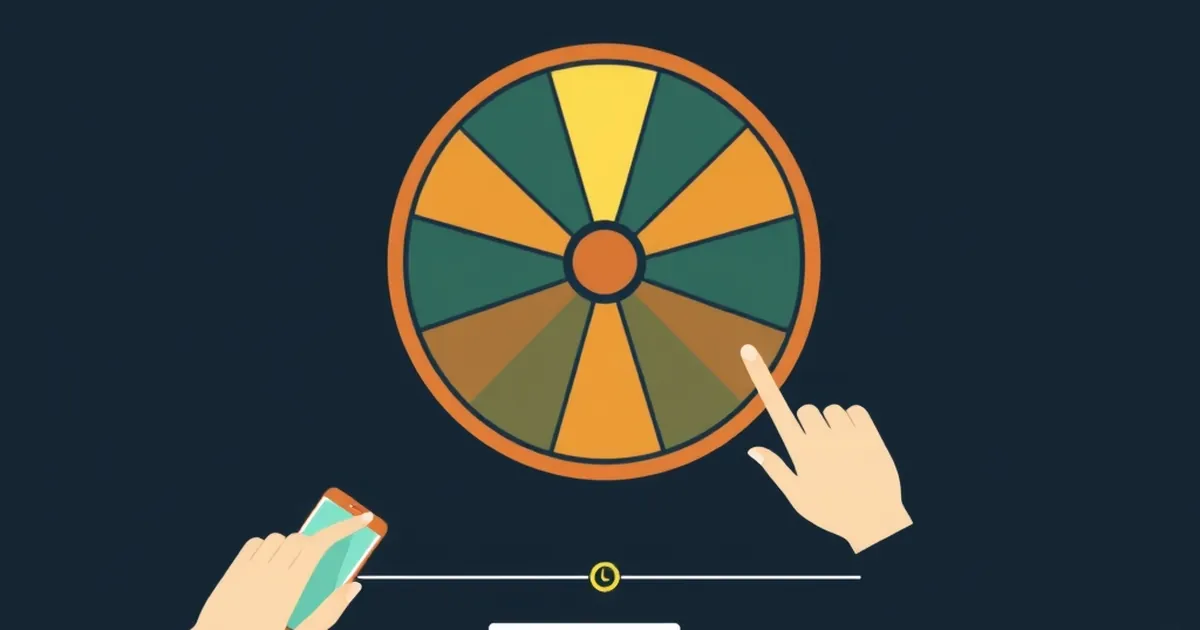
The wheel stops spinning, the pointer settles on a prize, and the interface needs roughly 200 milliseconds to paint the label that says what you won. In that gap — shorter than a blink, long enough for a human to register "something happened" — a meaningful share of users tap the screen again. In one instrumented build, 44% of players who saw the unlabeled pause tapped at least once more before the label appeared. The question worth sitting with isn't whether that's a bug or a feature. It's what those 200 milliseconds reveal about how people make decisions when the outcome is already decided but not yet disclosed.
The Anatomy of a 200ms Gap
To understand why anyone taps, you have to know what's actually happening on the wire. A bonus wheel animation isn't one event. It's a sequence: the client requests a spin result, the server computes and signs it, the animation plays on a fixed timeline, and the prize label renders only after the result payload resolves. If the animation is authored to finish at t=0 and the label waits on a network round trip, you get a visible seam. The wheel has "landed." The user has not been told what they landed on.
Most teams instrument the happy path — spin start, spin complete, prize shown — and never measure the seam between them. That's the first lesson for anyone building this kind of interface: the interesting behavior lives in the gaps your analytics don't name. A tap during the unlabeled pause is not a "spin" and not a "claim." It's an ambiguous event, and ambiguous events are where you learn the most about your users.
The engineering fix is trivial once you see it. Precompute the result before the animation starts, hold it client-side, and reveal the label on the animation's final frame rather than on a network callback. Or buffer the reveal behind a deterministic timer that doesn't depend on latency. Either way, you collapse the seam to zero. But collapsing it also erases a measurement — and the 44% number is worth understanding before you delete the evidence.
Why the label lags in the first place
Three common causes, in rough order of frequency: the result is fetched after the animation resolves instead of before; the label render is gated behind a separate asset load (fonts, sprite sheets, localized strings); or the animation is driven by a CSS transition whose completion event fires before the data is ready. None of these are exotic. All of them produce the same user-visible symptom: a settled wheel with no answer.
What the Extra Tap Actually Is
The intuitive read is impatience. The user wants the prize, the prize isn't there, so they tap. That's partly true, but it undersells what's happening. A tap in that window is a bid for information under uncertainty — the user has been shown that an outcome exists and has been denied the outcome's content. That's a specific, well-studied kind of discomfort.
Leon Festinger's work on cognitive dissonance and, later, the broader literature on ambiguity aversion (famously formalized by Ellsberg) both point at the same thing: people dislike unresolved states and will act to resolve them, sometimes at cost. A.B. holds that ambiguity is worse than known risk. In the wheel case, the user isn't risking anything by tapping — but the tap is a resolution-seeking behavior, an attempt to convert "something happened" into "here is what happened."
There's a second layer. The tap is also a probe: users have learned, from a lifetime of interfaces, that tapping produces response. When the interface goes quiet at the exact moment of maximum stakes, the tap is a test of whether the system is still alive. Is it frozen? Did I lose the connection? The unlabeled pause reads, to a nervous user, like a crash. The tap is partly a liveness check.
And a third: the tap is a rehearsal of the next action. If the user expects to have to claim, dismiss, or continue after the label appears, tapping early is a way of getting the finger into position. It's not random. It's anticipatory.
The 44% figure aggregates all three. That's why it's interesting and why it's dangerous to over-read. The number tells you the seam is behaviorally loud. It does not tell you why any individual tapped. To get at that, you need to segment.
Segmenting the taps
In the instrumented build, the taps split roughly into three cohorts worth naming. First, double-taps within 80ms of each other — these are liveness probes, the user checking the system isn't frozen. Second, single taps landing 120–180ms after the wheel settles — these are resolution-seeking, the user trying to force the label. Third, taps that arrive with the finger already moving toward where the continue button will appear — anticipatory, and the most likely to convert into an accidental action once the label does render.
That third cohort is where the real product risk lives. An anticipatory tap that lands on a "claim" button the instant it appears is functionally indistinguishable from a deliberate claim. Your analytics will record a claim. The user didn't make one. If the claim has any consequence — a currency spend, a commitment, a state change — you've now got a consent problem dressed as a UX problem.
Designing for the Seam Instead of Deleting It
The reflex is to eliminate the 200ms gap and move on. That's correct for the label, but it throws away a signal. A better pattern is to make the seam intentional and instrumented, then close it. Concretely: hold the result server-side before the animation begins, render the label on the animation's terminal frame, and log every input event in the window between "wheel settled" and "label painted" as a distinct telemetry category. You get the clean UX and the behavioral data.
This is the same discipline that shows up in high-availability systems generally. You don't just want the request to succeed; you want to know what the client did while it was waiting. Idempotency keys, request deduplication, and client-side input queues all exist because the network is unreliable and users are not patient. A bonus wheel is a small, vivid instance of the same problem: the server has the answer, the client doesn't yet, and the client is acting on that asymmetry.
The input-queue pattern
If you must have a seam — and sometimes you do, because the animation is the product — queue inputs rather than dropping or honoring them. A tap during the unlabeled window gets buffered, tagged with its timestamp and target coordinates, and either discarded on label paint (if it hit nothing meaningful) or surfaced as a confirm prompt (if it would have hit a consequential control). This is the same logic as a double-submit guard on a payment form: you don't silently accept the second submission, and you don't silently drop it either. You make the ambiguity explicit and resolve it deliberately.
The implementation is unglamorous. A small state machine with states settled_unlabeled, labeled, and interactive, plus an event buffer that flushes on transition. The interesting part is the policy: what counts as a consequential control, and what happens when a buffered tap lands on one. That's a product decision, not a technical one, and it should be made by someone who has thought about consent.
The Behavioral Economics of the Unlabeled Pause
Reward loops are usually discussed in terms of variable-ratio reinforcement — the Skinner finding that intermittent, unpredictable rewards produce the most persistent behavior. That's real and relevant to any interface with a randomized outcome. But the 200ms gap is a different phenomenon. The reward isn't variable here; it's fixed and already determined. What's variable is the disclosure. The user is not gambling on the outcome; they're waiting on the announcement.
That distinction matters because it changes which behavioral lever you're pulling. Variable-ratio reinforcement shapes whether someone comes back. Disclosure latency shapes what they do in the moment. The first is about retention; the second is about in-session behavior, and in-session behavior is where accidental actions and consent problems live.
Kahneman and Tversky's loss aversion is a better fit for a related question: does the unlabeled pause make the eventual prize feel larger or smaller? There's a plausible argument that a brief, unresolved anticipation inflates the perceived value of the reveal — the same way a held breath makes a punchline land. There's an equally plausible argument that it deflates it, because the user's attention has already been spent on the tap. The honest answer is that we don't know, and the 44% number doesn't tell us. Anyone who claims otherwise is selling something.
What we do know is that ambiguity is aversive and that people act to resolve it. The 44% is a clean demonstration of that in a controlled, high-stakes moment. It's also a warning: the same disposition that makes users tap also makes them tap through things — through confirmations, through warnings, through the very controls you built to protect them.
A note on the 44% itself
Treat the number as a starting point, not a benchmark. It came from one build with one animation length and one population. Change the animation duration and the tap rate will move. Change the label's visual weight and it will move again. The useful thing is the method: instrument the seam, segment the taps, and look at what fraction land on consequential controls. That last fraction is the one that should keep you up at night. It's almost certainly smaller than 44%, and it's the one that determines whether you have a UX problem or a liability.
What This Means for the Next Build
The forward-looking move is to treat disclosure timing as a first-class design surface, the way you'd treat latency or error states. Every interface that resolves an outcome after a delay — a spin, a match result, a bid acceptance, a payment confirmation — has a seam. Most teams don't know where theirs is, because they instrument the transitions they designed and not the gaps between them.
Three practices worth adopting now. First, define your seams explicitly in the state machine and give each one a name. A seam without a name is a seam you can't measure. Second, log inputs in every seam, not just the interactive states, and tag them by intent cohort (liveness, resolution-seeking, anticipatory). Third, decide the policy for consequential controls before the seam ships, not after the first support ticket.
The wheel that lands 200ms before its label is a small, vivid case. But the pattern generalizes to anything where the system knows the answer and the user doesn't yet — which, in a distributed system, is most of the interesting moments. The teams that get this right will be the ones that stopped treating the gap as a bug to be papered over and started treating it as a place where users reveal what they actually expect from the interface. The tap is the user telling you something. The job is to be listening before the label paints.