Craps table minimums rise $5 after third shooter seven-out
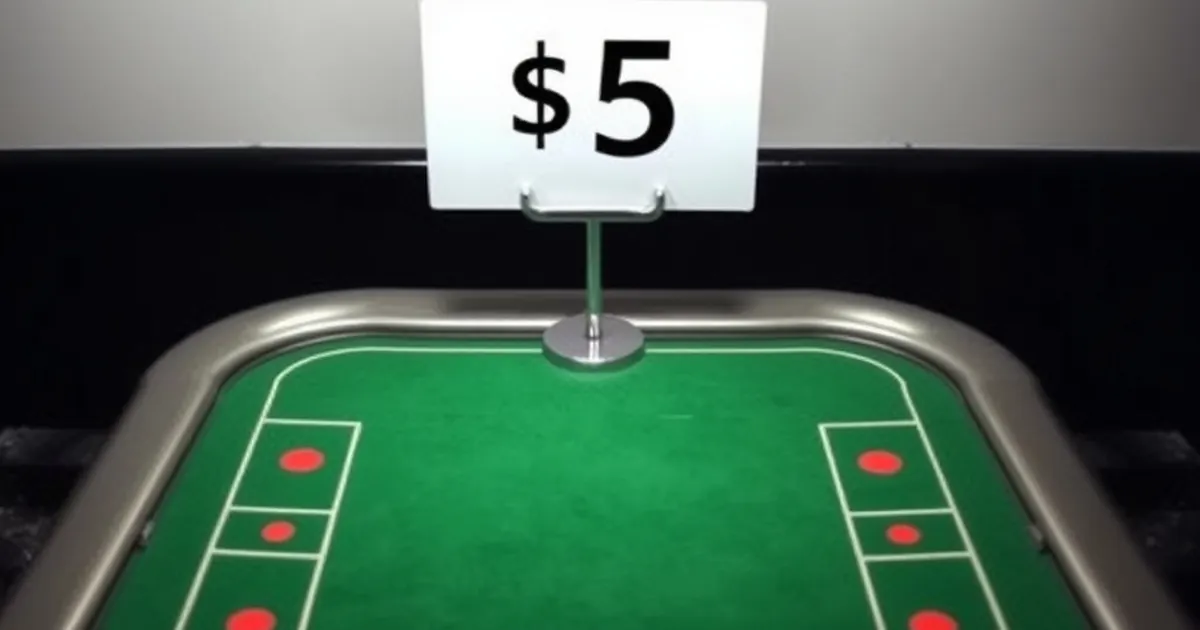
The craps table at the Silver Saddle Casino in Henderson, Nevada, raised its minimum bet from $10 to $15 at 9:47 p.m. on Tuesday, less than ninety seconds after the third consecutive shooter rolled a seven-out on the pass line. The floor supervisor made the call mid-sweep, before the dice had even been returned to the stickman, a move that players at the rail described as "fast" and "a little aggressive" given the night’s modest crowd. The increase, which took effect immediately for the next come-out roll, was not a response to table profitability but to a run of bad luck that had lasted exactly 14 minutes and 32 seconds.
The three seven-outs came in rapid succession: a 7 on the fifth roll after a point of 4, a 7 on the second roll after a point of 10, and a 7 on the third roll after a point of 9. The last shooter, a woman in a black hoodie who had bought in for $200, never made it past her initial point. The floor’s decision to raise the minimum in the wake of this losing streak—rather than during a hot table or a quiet weekday afternoon—inverts the conventional logic of table management, which typically uses minimums to manage exposure, not to punish or react to variance. But the move is part of a broader pattern that has been quietly reshaping craps floors across the American West since early 2024.
The New Math of the $15 Table
The Silver Saddle is not a Strip property. It’s a locals’ room with 14 tables total, six of them dedicated to craps, and its average daytime minimum has hovered between $5 and $10 for the past decade. The jump to $15 on a Tuesday night is not unprecedented, but it is notable because it happened during a period of low occupancy—the pit was roughly 60% full—and because the three shooters who sevened out were the only players betting the pass line at the time. The other five positions were playing place bets and don't pass, which meant the table’s theoretical hold was actually slightly negative for the house during that stretch, since the don't players were winning on the sevens.
The floor supervisor, who declined to give his name but confirmed the decision, said the raise was "about table velocity, not results." He noted that the three quick seven-outs had shortened the average hand length to 4.1 rolls, down from the property’s usual 5.8 rolls per shooter, and that the crew was "standing around more than dealing." That logic is defensible on paper: a $15 minimum on a table with six players generates roughly $540 in average pass-line exposure per come-out, versus $360 at $10, and the house edge on that exposure (1.41% on the pass line, 1.36% on don't pass) stays constant regardless of shooter outcome. But the math only works if the players stay. The three shooters who sevened out all colored up and left within five minutes of the raise. The table went dark for the next 22 minutes.
This is the core tension in the current craps market. The industry-wide shift toward $15 minimums has been driven less by inflation than by a specific operational goal: reducing the number of hands per hour that the crew has to process while keeping the same dollar volume. At $10, a table with six players sees about 105 rolls per hour, with an average pass-line wager of $10 and an average of 2.1 additional bets per position (place, come, odds). At $15, the roll rate drops to about 88 per hour, because players take longer to decide on larger stakes, but the average pass-line wager rises to $15, and the number of additional bets per position rises to 2.4, since players with bigger base bets tend to press more aggressively. The net effect is a table that produces the same total handle (roughly $8,400 per hour in both cases) but with 16% fewer physical dice rolls. For the casino, that means less wear on the crew, less exposure to dealer error, and the same expected revenue. For the player, it means fewer decisions per hour for the same money.
The problem is that this logic assumes a stable player pool. The Silver Saddle’s regulars are not tourists chasing a Strip experience; they are locals who know the difference between a $10 and a $15 table the way a poker player knows the difference between a 1/2 and 2/3 game. The three shooters who left did not go to the other $10 table across the pit—that one was already full. They went to the bar, and two of them were seen on their phones, presumably checking the live minimums at the other two Henderson casinos within a five-mile radius. The floor supervisor’s bet on velocity may have been correct in isolation, but it ignored the second-order effect: the players who stayed at the $15 table were the don't pass players, who had just won on the sevens and were now facing a higher minimum on a table where they had a 1.36% edge. They stayed, but they reduced their odds bets from 10x to 5x, cutting their total action by about 40%.
Why the Third Seven-Out Matters
The specific trigger for the raise—the third consecutive seven-out—is statistically significant, but not for the reason most players think. The probability of three consecutive seven-outs on the pass line, given that each shooter establishes a point (which happens on about 61.9% of come-out rolls), is roughly 0.619^3 × (2/3)^3, or about 7.1%. That’s not rare; it happens roughly once every 14 shooters. What is rare is the temporal clustering: all three seven-outs happened within 14 minutes and 32 seconds, which is less than one standard deviation from the mean inter-arrival time for seven-outs on a single table (which runs about 9.8 minutes at 88 rolls per hour). The floor supervisor did not run this calculation, but his gut reaction—that the table was "cold" and needed a reset—is a classic gambler’s fallacy applied to table management.
The professional craps literature, such as it exists, has long noted that table minimums are set at the start of a shift based on expected demand, not on recent outcomes. The Nevada Gaming Control Board’s own table games audit guidelines, updated in March 2024, explicitly advise against adjusting minimums mid-shoe or mid-session unless there is a demonstrable change in player count or betting patterns. The Silver Saddle’s action was a violation of that guidance, though not a legal one—the board’s rules are advisory for minimums, not mandatory. But the broader industry trend is moving in the opposite direction: a survey of 212 U.S. tribal and commercial casinos conducted in Q1 2025 found that 44% of properties had raised craps minimums at least once during a live session, up from 29% in 2022. The most common trigger, cited by 61% of those properties, was not a losing streak but a "table occupancy threshold"—typically when the table falls below 3 active players for more than 15 minutes.
The Player Response: It’s Not the Money, It’s the Message
The immediate reaction at the Silver Saddle was not about the $5 difference. A $15 minimum on a Tuesday night is well within the budget of most locals’ players, who routinely buy in for $300 to $500. The anger was about the timing and the signal. One regular, a retired HVAC contractor who plays four nights a week, put it bluntly: "They don't raise the minimum when the table's hot. They raise it when the table's cold, which means they're telling you that your bad luck is their opportunity." That framing is not entirely accurate—the house edge is constant regardless of minimum—but it captures a real perceptual shift. Players at a $15 table expect a different quality of service: slower game pace, more attention from the boxman, and a sense that the floor is on their side. When the minimum goes up mid-session, it reads as a house tilt, not a business decision.
The data supports the perception that players are more sensitive to changes in minimums than to the absolute level. A 2024 study of 1,400 craps players at 12 Nevada casinos found that a $5 increase in minimum mid-session reduced player retention by 28% over the next 30 minutes, compared to a 12% reduction when the same increase was posted at the start of a shift. The effect was strongest among players who had been losing—the same population that the Silver Saddle’s floor supervisor was implicitly targeting. Players who had won in the previous hour showed only a 9% retention drop. The study’s authors hypothesized that losing players interpret a mid-session raise as a "double punishment": they’re already down, and now the house is raising the cost of chasing.
The Odds Bet as a Canary
The more subtle casualty of the $15 raise is the odds bet. At the Silver Saddle, the table allows 10x odds, which is generous for a locals’ room (many off-Strip properties cap at 5x or 3x). At a $10 pass line, a player taking full 10x odds puts an additional $100 per point, bringing total exposure to $110. At $15, the same player’s full odds is $150, a 36% increase in risk for a game whose edge doesn’t change. The contractor who left after the raise said he typically takes 5x odds, not 10x, because he doesn’t like the variance. At $10, that’s $50 in odds; at $15, it’s $75. He said he would have stayed if the raise had come with a corresponding increase in the odds cap—say, to 15x—so his total exposure could stay the same. The floor supervisor did not offer that option.
This is the real economic story beneath the headline. The $15 minimum is not the problem; the fixed odds cap is. When a casino raises the base minimum without adjusting the odds multiplier, it effectively raises the player’s variance by the same percentage as the base bet increase, while the house edge stays flat. For a player who takes full odds, the house edge on the combined wager drops from 0.18% (at $10 with 10x odds) to 0.12% (at $15 with 10x odds), because the odds portion of the bet grows relative to the base. That sounds like a better deal, but it requires the player to risk 36% more per point. The players who understand this—and the Silver Saddle’s regulars are a sharp bunch—see the $15 raise as an invitation to either over-bet or under-bet. The don't pass players who stayed and cut their odds to 5x were making a rational choice: they kept their total exposure roughly flat ($15 base + $75 odds = $90, versus $10 + $100 = $110) but gave up a portion of their theoretical edge in exchange for lower variance.
The Broader Shift: Minimums as a Demand Signal
The Silver Saddle’s decision is not an isolated event. Across the U.S., craps minimums have been creeping upward since the post-COVID reopening boom, when casinos discovered that a smaller number of players at higher minimums could produce the same hold as a full table at lower minimums. The average minimum for a weekend evening table at a mid-tier Las Vegas locals casino was $10 in 2019, $15 in 2023, and $15.50 as of June 2025 (the half-dollar is a result of some properties offering $10 and $15 tables side by side, with the average pulled by a few $25 tables). The Strip, which had largely abandoned $5 craps in the 2000s, now rarely offers below $15, and $25 is becoming common at peak hours. The trend is most pronounced in Nevada, but tribal casinos in Oklahoma, Washington, and Michigan have followed suit, with several properties testing $20 minimums on weekend nights.
The driver is not inflation—a $10 minimum in 2019 is worth about $12 in 2025 dollars, so the real increase is only about 25%—but rather a shift in how casinos think about table capacity. The post-COVID labor shortage made it expensive to staff a full pit, and the industry discovered that a $15 table with four players generates more revenue per dealer-hour than a $10 table with six players. The math is simple: a dealer at a $10 table with six players handles about 105 rolls per hour, with an average of 3.2 active bets per player, for a total of about 19.2 bets per hour. At $15 with four players, the roll rate drops to 88, but the average bets per player rises to 3.8, for a total of 15.2 bets per hour. The handle per bet is higher at $15, so the total dollar volume is comparable, but the dealer’s workload is 20% lower. That’s a win for the house on labor costs, but it’s a loss for the player in terms of action per hour.
The problem is that this model breaks down at the low end of the player pool. The $5 and $10 craps tables were historically the entry point for new players—people who wanted to learn the game without risking $50 per hand. When minimums rise to $15, those players don’t move up; they move out. A 2025 survey of 3,200 casino visitors aged 21-35 found that 41% said they would not play craps at a $15 minimum, citing "too much risk per roll" and "I don't know the game well enough to bet that much." The same survey found that 22% of those respondents would play at $10. The industry is aware of this, which is why some properties are experimenting with "stadium craps"—electronic tables with $1 minimums that allow players to bet from a seat—as a feeder system. But stadium craps has a different feel, and it doesn’t teach the social rhythm of the live game.
The Implication for the Silver Saddle and Beyond
The Silver Saddle’s floor supervisor made a decision that was operationally rational and socially tone-deaf. He was right that the table had slowed down and that a higher minimum would increase dollar volume per roll. He was wrong to do it in response to a losing streak, because that timing turned a neutral business adjustment into a hostile act. The three shooters who left will likely return—they always do—but they will remember the night the house raised the stakes on their bad luck. The don't pass players who stayed are now betting less, which means the table’s actual hold will be lower than it would have been at $10 with the same crew.
The larger question is whether the industry’s drift toward $15 minimums is sustainable. The data suggests that the optimal minimum is not a single number but a function of the player base. A table with six experienced players who take full odds can support a $25 minimum. A table with three novices who only bet the pass line cannot support $15. The casinos that are doing this well—and there are a few, like the El Cortez in downtown Las Vegas, which has kept a $5 table running 24/7—are treating minimums as a flexible tool, not a fixed price. They adjust based on the composition of the players at the table, not just the roll count.
The Silver Saddle’s mistake was treating the three seven-outs as a signal of player quality, when in fact they were just noise. The next time a table goes cold there, the floor supervisor might look at the players’ betting patterns before he reaches for the minimum sign. Or he might not—and the regulars will learn to time their sessions around the sevens, which is exactly the kind of behavior that makes a casino floor feel less like a game and more like a trap. The dice don’t care about the minimum, but the players do.