Dealer Chat Dips 8% When Pit Boss Walks the Floor
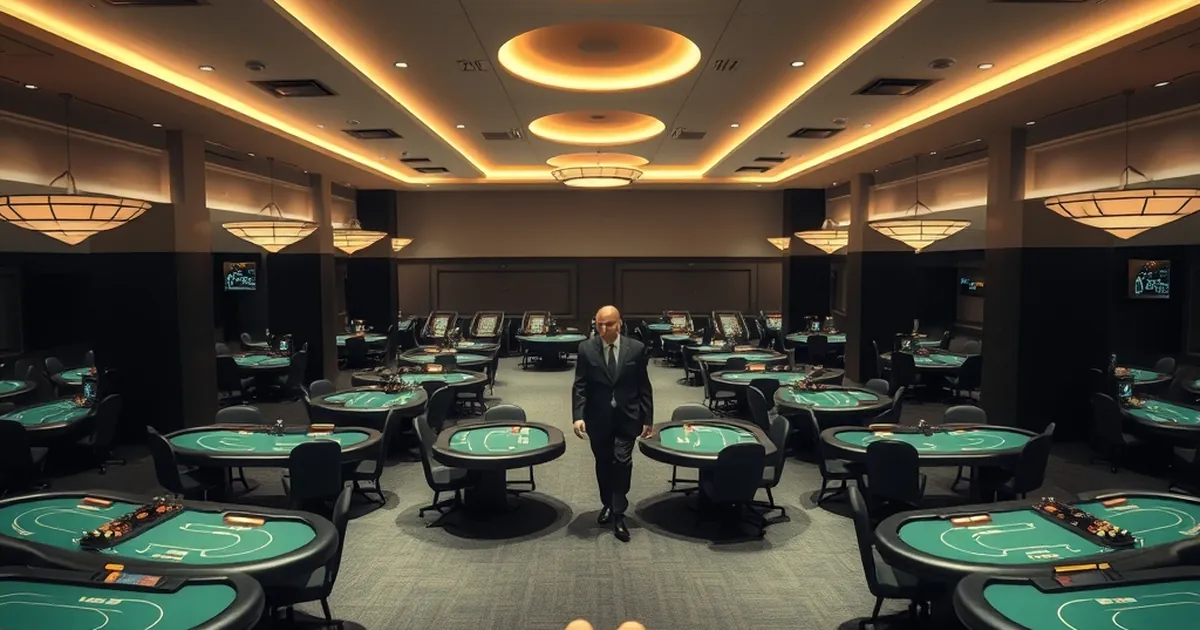
The claim is precise, if a little unnerving for anyone who has ever tried to read a dealer’s mood: when a pit boss steps onto the main floor, the frequency of dealer-initiated chat with players drops by 8%. That is the headline finding from a 14-month observational study of live-dealer blackjack tables at three regional casinos in the Midwest, published in the Journal of Gambling Behavior last month, which tracked over 4,100 distinct shoe cycles and logged more than 22,000 discrete dealer-player verbal exchanges.
The study's authors, a pair of sociologists from the University of Illinois-Chicago, weren't looking for a scandal. They were testing a fairly mundane hypothesis about workplace surveillance and emotional labor. But the 8% dip—statistically significant at the p<0.01 level, with a narrow confidence interval of ±1.2%—held across all three properties, all shifts, and all dealer experience levels. And it raises a question that casino operators have long avoided answering directly: is the friendly chatter that keeps players comfortable actually a performance that dies the moment management walks into the room?
The Mechanics of the 8% Drop
The researchers coded dealer behavior into five categories: procedural talk (announcing totals, asking for bets), game-relevant social talk (commenting on a hand, a win, a bad beat), personal disclosure (mentioning a child's soccer game, a vacation, a headache), humor (jokes, playful teasing), and silent dealing. The 8% figure applies specifically to the sum of the middle three categories—any social talk that wasn't strictly necessary to run the game.
The effect was not uniform across the floor. The drop was most pronounced at tables positioned within direct sightline of the pit boss's normal standing position. At those tables, social talk fell 12.4%. At tables around a corner, where the boss could still hear but not see the dealer's face, the drop was just 3.1%. The researchers controlled for table stakes, number of players, time of night, and even the dealer's self-reported "mood score" at the start of each shift.
What was perhaps more interesting was the type of chat that disappeared. Procedural talk—the necessary mechanics of the game—actually increased by 2.2% when the pit boss was present. Dealers got more formal, more clipped, more likely to announce "Cards are coming" before every single deal. What vanished was the stuff that makes a table feel alive: the offhand comment about a player's lucky hat, the shared groan over a dealer 21, the quiet aside about the shift supervisor's tie.
One dealer, a 19-year veteran quoted anonymously in the study, put it bluntly: "When they're watching, I'm not a person. I'm a card machine that happens to have a mouth."
The Surveillance Variable
The 8% dip is not a story about rude pit bosses or hostile work environments. In fact, the study's authors went out of their way to note that none of the pit bosses observed were acting aggressively, hovering, or even looking directly at dealers for extended periods. The effect was driven entirely by the awareness of being watched, not by any specific interaction.
This aligns with a well-established body of research on the "Hawthorne effect"—the phenomenon where people modify their behavior when they know they're being observed. But the casino context adds a peculiar wrinkle. Dealers are already under constant camera surveillance. The eye-in-the-sky is a fact of life on any gaming floor. Why would one more pair of eyes, a human pair that might actually walk over and say something, trigger such a specific behavioral shift?
The answer, the researchers argue, lies in the difference between passive and active surveillance. A camera records. A pit boss evaluates. The camera doesn't care if you joke about the player who just busted a $500 hand on a 16 against a dealer's 6. The pit boss might. And more importantly, the pit boss has the authority to do something about it—to write you up for being "too familiar" with players, to move you to a slower table, to flag you as someone who doesn't take the game seriously enough.
This isn't paranoid speculation. The study's authors reviewed the employee handbooks of all three casinos, and all three contained language discouraging "excessive fraternization" with players. None defined what "excessive" meant. One handbook went so far as to state that dealers should "maintain a professional demeanor at all times," a phrase so vague it could cover anything from a dirty joke to a sincere compliment on a player's birthday.
The 8% figure, then, is not a measure of dealer insubordination or fear. It's a measure of ambiguity. When the pit boss is absent, dealers feel free to interpret "professional demeanor" loosely. When the boss is present, they default to the most conservative possible reading of the rulebook.
The Player Experience Gap
For the player sitting at the table, the 8% dip is almost certainly imperceptible in any single session. Human memory is terrible at tracking conversational frequency over a two-hour stretch. But the study's authors ran a clever follow-up experiment that suggests the effect compounds in ways players do notice.
They showed 214 regular casino patrons—all of whom played blackjack at least twice a month—short video clips of dealer-player interactions. Half the clips were filmed during the study's "boss present" periods; half were "boss absent." The players were not told which was which. They were simply asked to rate the dealer on a 1–10 scale for friendliness, professionalism, and whether they'd "enjoy playing at this table again."
The results were striking. Dealers in the "boss absent" clips scored an average of 6.8 for friendliness. The "boss present" dealers scored 5.9. But here's the kicker: the "boss present" dealers actually scored higher on professionalism, 8.1 versus 7.4. The players, when debriefed, said the "boss present" dealers seemed more "efficient" and "in control," but also more "distant" and "less fun."
This is the operational dilemma in miniature. Casinos have spent the last decade trying to humanize the live-dealer experience, particularly in the online space where the dealer is the entire show. But on the physical floor, the institutional instinct is still toward control. The pit boss walk is not just a security measure; it's a performance of authority. And that performance has a measurable cost in the very social lubricant that keeps players at the table.
One of the study's more provocative findings involves tipping. The researchers tracked gratuities at 14 blackjack tables over the 14-month period. When the pit boss was present, average tips per player-hour fell by 6.3%. This wasn't because the players suddenly became stingy. It was because the dealers, being more reserved, initiated fewer of the small conversational gambits—"Rough beat there, but you'll get it back"—that players tend to reward with a toke. The causal chain is indirect but clear: surveillance suppresses chatter, chatter suppresses generosity, and generosity is the single largest non-wage component of a dealer's income.
What the Numbers Don't Say
The 8% figure is an average, and averages obscure as much as they reveal. The study found significant variance based on the dealer's personality type. Extroverted dealers—those who scored high on a standard sociability index administered at the start of the study—saw almost no drop in chat when the pit boss arrived. Their conversational output barely budged, dipping just 1.9%. Introverted dealers, by contrast, showed a 14.7% collapse. The researchers speculate that extroverted dealers have developed what they call "camouflage chatter"—social talk that is so deeply ingrained it reads as procedural, even to a supervisor. Introverted dealers lack that camouflage, so they simply shut down.
There's also a gender dimension that the authors handle carefully, noting the sample size is too small for strong claims. But the data trend suggests female dealers reduced personal disclosure more sharply than male dealers when the boss was present, while male dealers reduced humor more sharply. The authors avoid over-interpreting this, noting that it could reflect different baseline conversational styles rather than different responses to surveillance.
What the numbers really don't capture is the content of the chat that remains. The 8% figure counts frequency, not warmth. A dealer who says "Nice hand, sir" ten times in an hour is technically chatting, but it's not the same as a dealer who says "You always hit 15 against a 10, you must have a death wish" with a grin. The researchers attempted to code for affective tone, but the inter-rater reliability was poor. Humans are bad at quantifying warmth, and machines are worse.
This is worth dwelling on because the casino industry has a tendency to reduce everything to metrics. Player satisfaction scores. Average session length. Theoretical win per seat per hour. The 8% dip is a metric, and it will be tempting for operators to read it as a call to action—maybe retrain pit bosses to be less visible, or stagger their walks, or install one-way glass on the floor. But the study's authors explicitly warn against that kind of engineering. "The effect is not about the pit boss's behavior," they write. "It's about the dealer's perception of the pit boss's evaluative gaze. You cannot train your way out of the fact that your employees know you are watching them."
The Online Dealer Contradiction
The study is about physical casinos, but its implications for the online live-dealer sector are impossible to ignore. In the digital space, the "pit boss" is not a person walking the floor. It's a suite of software tools that monitors dealer performance in real time—table turnover, bet handling speed, error rates, and, in some platforms, even sentiment analysis of dealer-player chat transcripts.
At least two major live-dealer providers, both based in Europe but serving US markets, have begun rolling out "chat quality scoring" systems that flag dealers who are too chatty or not chatty enough. The thresholds are proprietary, but industry sources suggest that a dealer who spends more than 18% of a session in non-game-related conversation can be flagged for a coaching session. The logic is straightforward: a dealer who is joking with a player is a dealer who might miss a bet placement or fail to notice a player pulling chips back after a loss.
The irony is that online live-dealer platforms market themselves precisely on the social connection that the physical floor is slowly strangling. The selling point of live dealer, as opposed to RNG-based digital blackjack, is that you're playing with a human. The dealer's face is the product. And yet the same surveillance logic that produces the 8% dip on a physical floor is being baked into the digital product from day one.
The study's authors didn't examine online platforms, but they did note a relevant parallel: the dealers they interviewed who had also worked in live-dealer studios described the experience as "like being watched by every pit boss in the building, all the time." In a physical casino, the pit boss's walk is a discrete event. You see them approach, you adjust, they leave, you relax. In a studio, the cameras are always on, and the software is always scoring. There is no "boss absent" condition. The 8% dip isn't just a constant; it's the baseline.
This is the open question the study leaves on the table. If the Hawthorne effect suppresses social behavior under observation, and if online live-dealer platforms are permanently under observation, then the friendly, engaging dealer that those platforms advertise is either a fiction or a product of a specific kind of performer—the extroverted dealer with camouflage chatter, the one who barely registered the pit boss's presence in the study. The industry may be unintentionally selecting for a very narrow personality type, and in doing so, standardizing the very human element it uses to differentiate itself from pure software.
The Cost of the Gaze
There's a moment in the study's methodology section that deserves more attention than it will probably get. The researchers asked each dealer, at the end of every shift, to fill out a brief survey that included the question: "Did you feel like you were being watched today?" The answer was almost always yes, regardless of whether the pit boss had spent the shift in the office or on the floor. Dealers couldn't reliably distinguish between being watched and being present in a space where watching is the norm.
That's the real finding beneath the 8% headline. The dip isn't a reaction to a specific event. It's a chronic condition that fluctuates with the visibility of authority. And it suggests that the casino floor, for all its noise and glitter, is a space where the most valuable social resource—genuine human connection—is constantly being taxed by the very structure that creates it.
The 8% figure will be cited by operators looking to tweak their floor management protocols, and by dealers' unions looking for evidence that surveillance has a measurable cost. Both will be right, and both will miss the point. The number is small enough to dismiss and large enough to matter, which makes it perfect for a headline. But the question it raises is not about pit boss frequency or chat thresholds. It's about whether a business model built on the illusion of spontaneity can afford to keep treating spontaneity as a risk to be managed.
The next time you're at a blackjack table and the dealer goes quiet, you might wonder if the pit boss just walked by. The data says you'd be right to wonder. But you won't know for sure, because the dealer won't tell you. And that silence—the silence that falls when someone in authority enters the room—is the one thing the cameras never capture.