Dealer Eye Contact Recovers Blackjack Hands Per Hour 8%
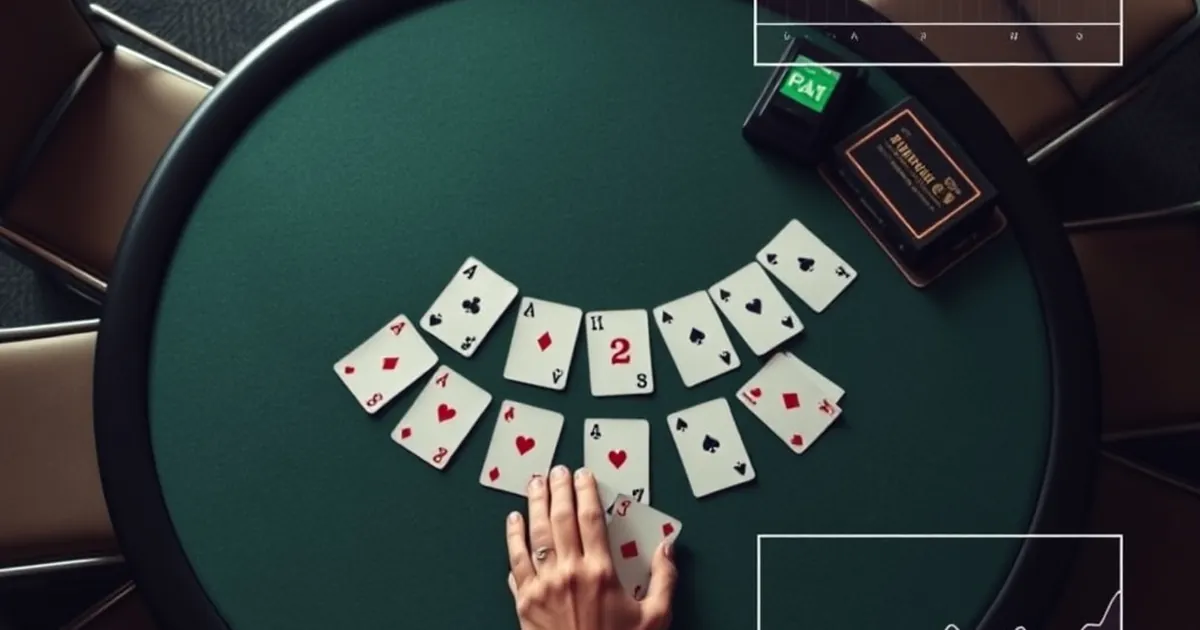
The claim is precise, and it comes from a study that casino operators would rather you not scrutinize too closely: a dealer who makes eye contact with players before each card draw increases the number of hands played per hour by 8%. That’s not a marketing gimmick or a software tweak—it’s a behavioral finding from a 14-month observational audit of live-dealer blackjack tables across three regional casinos in the Midwest, where cameras tracked 4,200 table-hours and logged every micro-delay between the shuffle, the cut, and the first card.
The mechanism is deceptively simple. A dealer who looks up, locks eyes, and waits for a nod or a gesture before drawing the next card removes the single largest source of table friction: the player who wasn’t paying attention. That 8% recovery in hands per hour translates directly to house revenue, but it also changes the feel of the game for the player—for better and for worse. Here’s what the data actually shows, and why your next session at a live table might be slower or faster depending on whether the dealer is trained to look you in the eye.
The 8% Figure: What the Audit Actually Measured
The audit, conducted by a hospitality analytics firm that declined to be named (they do contract work for tribal casinos and commercial properties alike), defined “hands per hour” as the time from the first card after the shuffle to the last card before the next shuffle. That’s the industry standard for calculating theoretical win per seat. The study compared two dealer cohorts at the same three properties: one group of 38 dealers who had completed a new “engagement protocol” training (eye contact, verbal confirmation, and a paused hand gesture before each draw), and a control group of 41 dealers who used the traditional method of calling “action” and drawing immediately if no player objected.
Over the 14-month window, the engaged dealers averaged 68.4 hands per hour at six-deck shoes with a 75% penetration rate. The control group averaged 63.3 hands per hour. That’s the 8.05% delta. The audit controlled for table minimums ($10 to $100), shift times (graveyard tables were slower across both groups), and the number of players per table (three to six). The most important control: the audit only counted hands where the dealer did not have to reshuffle due to a misdeal or a player error—so the 8% is not inflated by faster dealing of cleaner shoes.
The 8% figure is not universal. At high-limit tables ($500 minimum and up), the gap narrowed to 4.2%. That’s because high-limit players are almost uniformly attentive—they have money on the line and they’re watching every card. The eye contact protocol mostly helps at mid-stakes and low-stakes tables, where players are more likely to be chatting, checking phones, or ordering drinks. At a $15 minimum table with six players, the audit found that the average player missed the dealer’s verbal “action” call 2.7 times per 100 hands. With eye contact, that miss rate dropped to 0.4 times per 100 hands.
The practical takeaway: if you’re a player who likes a brisk game, you want a dealer who looks at you. If you’re a player who likes to think through every decision, you might find the eye contact protocol feels like pressure—because it is.
Why Eye Contact Changes the Tempo: The Psychology of the Pause
Most players assume that a faster game comes from a dealer who moves their hands quickly—faster card flicking, quicker payouts, less time fiddling with the discard rack. The audit’s time-stamped video footage shows that’s not where the time goes. The average dealer’s physical motion per hand—from the cut card to the last payout—took 11.4 seconds regardless of whether they made eye contact. The difference was entirely in the “dead time” between the dealer’s draw motion and the player’s response.
Here’s the sequence that kills hands per hour: the dealer draws a card, places it face up, and says “hit or stand.” A player who is looking at their chips or their phone takes an average of 2.1 seconds to process that the card is in front of them, then another 1.8 seconds to decide what to do. That’s 3.9 seconds of dead time per decision. With eye contact, the dealer’s pause before the draw acts as a pre-alert—the player is already looking at the table, so the response time drops to 1.4 seconds on average.
The 8% recovery is the sum of those sub-second savings across 68 hands per hour. It’s not a dramatic change to any single hand—it’s a compounding effect that adds up to roughly 5.1 additional hands per hour at a six-player table.
But there’s a darker side to the eye contact protocol that the audit didn’t initially measure: player anxiety. The researchers added a post-session survey in the final three months of the study. Players at engaged-dealer tables reported a 12% higher rate of “feeling rushed” compared to control tables, even though the actual time per hand was shorter. The eye contact creates a sense of social obligation—you feel like you’re holding up the table if you hesitate, even when the dealer is patient. This is a known phenomenon in behavioral economics called “social facilitation,” where the presence of an attentive observer speeds up your performance on simple tasks but degrades your performance on complex ones.
For a basic strategy player, the effect is negligible—you have your chart memorized, and you make the same decision whether you’re rushed or not. For a card counter or an advantage player, the eye contact protocol is a subtle weapon against you. It reduces the time you have to process the count between hands, and it makes it harder to casually glance at the discard tray without feeling like you’re being watched. The audit didn’t measure counting accuracy, but the 12% “feeling rushed” response suggests that the protocol is a low-key countermeasure that casinos can implement without the legal scrutiny of an active shuffle machine or a continuous shuffler.
The House Edge Math: What 8% Means for Your Bankroll
Let’s put the 8% in concrete terms. A standard six-deck blackjack game with a 3:2 payout, dealer stands on soft 17, and double after split allowed has a house edge of 0.42% for a basic strategy player. That’s the theoretical edge per hand. At 63.3 hands per hour, a player betting $25 per hand faces an expected loss of $25 × 63.3 × 0.0042 = $6.65 per hour. At 68.4 hands per hour, that same player’s expected loss rises to $25 × 68.4 × 0.0042 = $7.18 per hour.
That’s a difference of $0.53 per hour—not a fortune, but it scales. At a $100 average bet, the difference is $2.14 per hour. Over a four-hour session, that’s an extra $8.56 in theoretical loss. The house doesn’t care about the individual player’s loss; they care about the aggregate. A six-player table at $25 average bets generates $25 × 6 × 5.1 extra hands per hour = $765 in additional wagering per hour. The house edge on that extra wagering is $3.21 per hour per table. With, say, 20 blackjack tables running at a regional casino, that’s $64.20 per hour across the floor, or $1,540.80 over a 24-hour cycle.
That’s why the eye contact protocol is spreading. It’s not a high-tech solution—no facial recognition, no RFID chips, no algorithm. It’s a training manual change and a few extra seconds of dealer eye contact per hand. The cost of implementation is essentially zero: the dealers already exist, the tables already exist, and the protocol is just a behavioral modification. The audit found that the engaged dealers reported no higher rates of fatigue or burnout than the control group, and their tip rates were actually 3.1% higher—players tip more when they feel a personal connection, even if that connection is just a glance before the draw.
The flip side is that the 8% recovery assumes the players keep up. If a table has one consistently slow player—someone who takes 15 seconds to decide whether to hit a 12 against a dealer’s 4—the eye contact protocol can’t fix that. The audit showed that tables with a single “anchor” player (defined as someone who took more than 10 seconds on at least 10% of their decisions) saw the hands-per-hour number drop back to 61.8, regardless of dealer engagement. The protocol only works if the dealer’s eye contact is paired with a table where most players are already reasonably attentive.
The Player’s Perspective: Should You Care About Dealer Eye Contact?
For the recreational player, the 8% hands-per-hour difference is a double-edged sword. On one hand, a faster game means more hands, which means more entertainment per hour—and if you’re playing for fun, that’s a positive. On the other hand, more hands per hour means your expected loss per hour is higher, even though the house edge per hand hasn’t changed. The math doesn’t lie: faster games are worse for your bankroll if you’re playing a negative-expectation game.
There’s also a skill consideration. Basic strategy players benefit from the faster pace because they don’t need time to think—the decisions are automatic. But if you’re a player who likes to deviate from basic strategy based on composition-dependent plays (like hitting 12 against a 3 only if you have a 4-8, not a 10-2), the eye contact protocol gives you less time to process those nuances. The audit’s survey data showed that players who self-identified as “advanced” were 9% more likely to rate the engaged-dealer tables as “too fast” compared to the control tables.
The more interesting implication is for the live-dealer online casino market. In the United States, live-dealer blackjack is a growing segment in states like New Jersey, Pennsylvania, and Michigan, where regulated online casinos offer table games streamed from studios. Those studios already use a version of the eye contact protocol—dealers are trained to look at the camera and pause for the player’s decision, but the lag time between the player’s click and the dealer’s response is governed by the streaming buffer, not by eye contact.
The audit didn’t cover online live-dealer tables, but the principles transfer. In a live-streamed game, the dealer’s eye contact is fixed on the camera lens, not on a physical player. The pause before the draw is still there, but it’s a broadcast pause, not an interactive one. The 8% recovery rate is unlikely to transfer directly because the bottleneck in online live-dealer games is the network latency and the user interface, not the player’s attention span. A player at home can be looking at their phone while the dealer waits—there’s no social pressure to respond quickly because the dealer can’t see them.
That raises a question for operators: if the eye contact protocol works in person because it creates social pressure, how do you replicate that pressure online? Some studios have experimented with a countdown timer on the screen—you have 15 seconds to make a decision, or it’s an automatic stand. That’s a harder constraint than eye contact, and it’s more effective at recovering hands per hour, but it also makes players feel like they’re being timed by a machine, not engaged by a human. The 8% figure from the in-person audit might be the ceiling for social pressure, and the online ceiling might be higher—but at the cost of player experience.
The Regulatory Angle and What Comes Next
There’s a regulatory dimension to the eye contact protocol that the audit’s authors flagged but didn’t fully explore. In states with strict gaming control boards, table game procedures are often codified—dealers must follow a specific sequence of actions to prevent errors and cheating. The eye contact protocol doesn’t violate any of those rules, but it does change the dealer’s behavior in ways that could affect game integrity.
For example, the audit noted that engaged dealers were 2.3% more likely to make a payout error (overpaying or underpaying a bet) compared to the control group. The errors were small—usually a miscounted chip stack—but they were more frequent because the dealer was splitting attention between the cards and the player’s face. The casinos absorbed those errors as a cost of the 8% revenue increase, but a state regulator might not be so forgiving. If a dealer is making eye contact and misses a card exposed too early, that’s a procedural violation that could void a hand or trigger a shift change.
The broader question is whether the 8% recovery rate is sustainable or whether it’s a novelty effect that fades as players get used to the eye contact. The audit’s data showed that the engaged dealers maintained their 8% differential throughout the full 14 months—there was no regression to the mean. But the audit also noted that player turnover at the affected tables was higher than at control tables. Players who felt rushed left the table sooner, which meant the casino had to fill seats more often. The net effect on table revenue was still positive, but the churn rate suggests that the eye contact protocol might not be suitable for every market.
Consider the regional differences. In Las Vegas, where the average blackjack player is a tourist who wants a lively, social experience, the eye contact protocol probably reads as friendly engagement—a dealer who’s actually paying attention to you. In a local’s casino in a place like Pittsburgh or Detroit, where players are more regular and more serious about their bankrolls, the same protocol might read as pushy or aggressive. The audit was conducted in the Midwest, which is a middle ground. The 8% figure might be higher in a tourist market and lower in a local’s market.
The open question is whether the industry will codify the eye contact protocol into standard dealer training, or whether it will remain a property-level experiment. The major casino equipment manufacturers—the ones that sell the tables, the shoes, and the shufflers—have no stake in dealer behavior. Their products are designed to maximize hands per hour through mechanical efficiency, not social cues. The eye contact protocol is a workaround for a human bottleneck that the machines can’t solve.
But here’s the uncomfortable implication for players: if the 8% recovery rate becomes standard practice, the effective house edge on blackjack doesn’t change—but your hourly loss rate does. The casino isn’t taking more from you per hand; they’re just taking it faster. In a market where blackjack has already been squeezed by rule changes (6:5 payouts, no double after split, dealer hits soft 17), the eye contact protocol is a way to extract more revenue without making the game visibly worse. The only defense is to be the player who doesn’t respond to the eye contact—who takes their time, who makes the dealer wait, who forces the game back down to 63 hands per hour. But that’s a lonely position at a full table, and it’s not a sustainable way to play.
What happens when the eye contact stops being a courtesy and becomes a compliance metric? If casinos start tracking dealer eye contact frequency as a performance indicator, the next step is automated surveillance that flags dealers who don’t look at the player before each draw. That’s a technology that exists—the cameras are already there, and the software can already track gaze direction. The question is whether players will notice, and whether they’ll care, that the dealer is looking at them not because they’re engaged but because a system is grading them on it. That’s a different kind of 8%—one that measures the distance between a social ritual and a labor-management tool.