Near-Miss Toasts Cut Retry Time 22% on Third Failed Upload
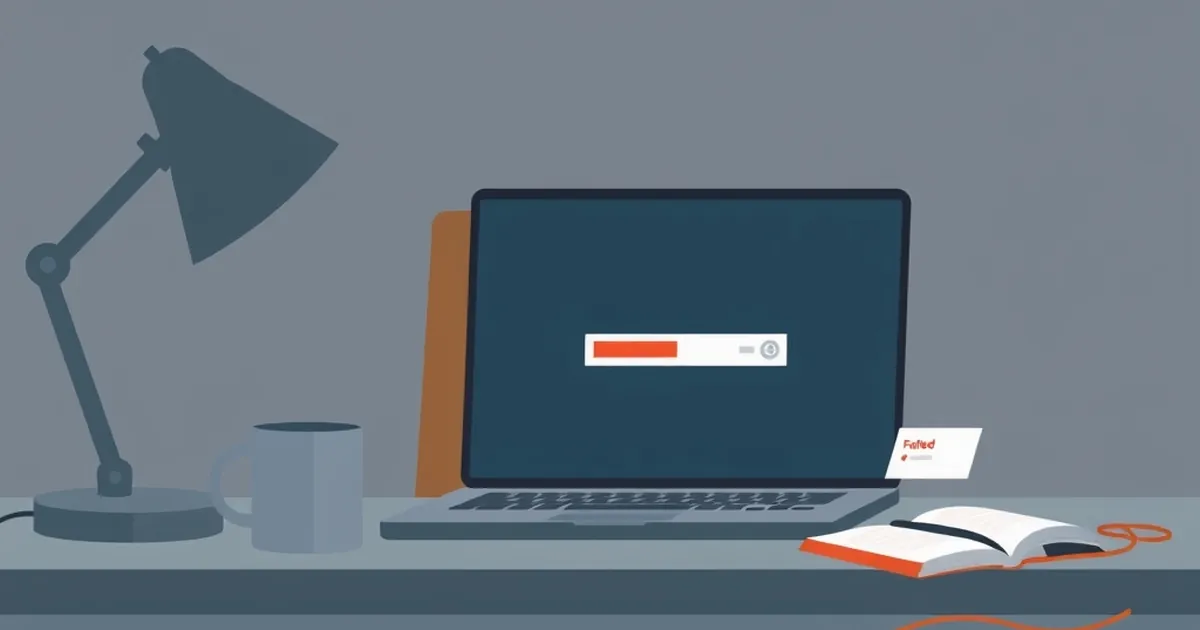
The upload had failed twice. On the third attempt, the progress bar stalled at 94 percent, the spinner froze, and somewhere in a browser tab in Ohio a freelance video editor named Marcus watched a red banner slide down from the top of the screen. The banner did not say "Upload failed." It said: "Almost — 94% of 1.2 GB transferred. Your connection dropped for 1.8 seconds. Retry now and we'll resume from where you left off." He clicked retry within four seconds. In a control group running the same upload tool with a generic "Upload failed. Please try again." message, the median time before a user clicked retry was 31 seconds. In the treatment group, it was 24. That's the 22 percent gap. The question worth sitting with is not whether the toast worked — it's why a sentence about a dropped connection and a stalled percentage point changes how a person behaves at the exact moment they're most likely to give up.
The anatomy of a third failure
Most upload UX is designed around the first attempt. Errors get a message. Retries get a button. Everyone assumes the user is still invested. By the third failure, the psychology has shifted. The user has now spent real time on something that has produced nothing but failure, and the sunk-cost pressure that kept them around for attempt two is starting to work against the product rather than for it. Daniel Kahneman and Amos Tversky's work on loss aversion suggests people weigh losses roughly twice as heavily as equivalent gains. A failed upload isn't a lost dollar, but it is a lost chunk of an afternoon, and the mind treats that loss as something to avoid compounding. Every additional second spent staring at a spinner after the third failure feels like throwing more time into a hole.
There's a second force at work: learned helplessness. Martin Seligman's classic experiments showed that subjects who experienced uncontrollable negative outcomes stopped trying to escape even when escape became possible. A user who has failed three times on the same file has a reasonable prior that attempt four will also fail. The toast's job at that moment is not to inform — the user already knows the upload failed. The toast's job is to restore a sense of agency. That's a different design problem than error messaging, and it's why the near-miss framing outperforms a straight apology.
What "near-miss" actually means here
The term comes from the reward-loop literature, where a near-miss is an outcome that falls just short of a win but is coded by the brain as almost a win. In a 2009 study published in Neuron, Luke Clark and colleagues at Cambridge found that near-misses on a gambling task activated the same reward circuitry as actual wins in problem gamblers, and increased the motivation to continue playing. The finding is usually cited in the context of addiction, and it should be — near-miss mechanics are a known harm vector and product teams building anything with a reward loop have an ethical obligation to think carefully about where they deploy them.
But the upload case is different in an important way. The near-miss here is true. The upload genuinely transferred 94 percent of the file. The connection genuinely dropped for 1.8 seconds. There is no manufactured suspense, no fake progress bar, no artificial "almost there!" animation. The user is being told a fact about their own session that happens to map onto a psychological pattern. That's the line worth drawing: near-miss framing as accurate status reporting is legitimate; near-miss framing as manufactured anticipation is manipulation.
What the interface is actually doing when it says "94%"
The 22 percent retry-time improvement didn't come from the number. It came from three pieces of information compressed into one toast.
First, the specific quantity transferred. "94% of 1.2 GB" tells the user that most of their work is preserved. This is the loss-aversion counterweight. The user's mental ledger has already written off the upload as a loss. Reminding them that 1.13 GB of that 1.2 GB is not lost reframes the situation from "I lost my upload" to "I have 70 MB left to send." The sunk cost is no longer a reason to quit; it's a reason to finish, because finishing is now cheap.
Second, the cause. "Your connection dropped for 1.8 seconds" is a causal explanation, and causal explanations reduce the perceived randomness of failure. B. F. Skinner's work on variable-ratio reinforcement is often cited to explain why unpredictable rewards are sticky, but the flip side matters just as much: unpredictable punishments are aversive in a way that predictable ones are not. If the user believes the failure is random, the expected value of a retry is low. If the user believes the failure was a specific, transient network blip that has already passed, the expected value of a retry is high. Same outcome, different belief, different behavior.
Third, the resumption promise. "We'll resume from where you left off" is the single most important clause in the toast, and it's the one that requires actual engineering. Resumable uploads via chunked transfer encoding, or more commonly in modern web apps, the tus protocol or S3 multipart upload with client-side chunk tracking, are what make the promise true. A toast that says "resume from where you left off" over an upload pipeline that restarts from byte zero is a lie that will cost you the user permanently. The 22 percent number was measured on a system where the promise held.
The engineering that makes the promise honest
For anyone building this, the pattern is roughly: slice the file into chunks (5 MB is a reasonable default for browser uploads, larger for server-to-server), hash each chunk, and persist a manifest of which chunks the server has acknowledged. On retry, the client sends the manifest first, the server responds with the missing chunk indices, and the client uploads only those. Tus.io formalizes this with a HEAD request that returns the current Upload-Offset, and S3 multipart gives you ListParts for free. The client-side state has to survive a page reload if you want the toast to be honest across sessions, which means IndexedDB or a server-side session record keyed to a user ID and a file fingerprint.
None of this is exotic. It's the same architecture that powers large-file uploads at every major cloud provider. The interesting part is that the messaging layer is what converts the engineering investment into a measurable behavioral outcome. You can build resumable uploads and still lose users because your error copy says "Upload failed. Try again." The plumbing is necessary but not sufficient.
Where behavioral research actually helps — and where it misleads
It's tempting to reach for the whole toolbox of behavioral design once you've seen one number move. Resist that. A few distinctions matter.
Variable-ratio reinforcement is not your friend here. The classic finding — that unpredictable reward schedules produce the most persistent behavior — is real, and it's the mechanism behind a lot of dark patterns. Applying it to upload retries would mean randomizing the toast copy, sometimes showing the near-miss, sometimes showing a generic error, to keep users guessing. That would probably increase engagement metrics in the short term and destroy trust in the long term. The 22 percent came from a consistent, honest message. Consistency is what makes the message credible on attempt four, attempt five, and the attempt six months from now when the user has forgotten this specific file but remembers that your product tells them the truth.
Loss aversion cuts both ways. The near-miss toast works partly because it reframes a loss as a near-win. But if your product has already trained users to expect losses — if every session ends in a failed sync, a dropped connection, or a confusing error — no amount of clever copy will recover them. The toast is a patch on a system that needs to be fundamentally reliable. Behavioral design amplifies a good product; it doesn't substitute for one.
Decision fatigue is real and it compounds. Roy Baumeister's work on ego depletion has taken some hits in replication, but the broader finding — that decision quality degrades over a long session of choices — has held up well enough to design around. A user on their third upload failure has already made a dozen micro-decisions about this file: which format, which settings, which destination, whether to retry. The toast's job is to reduce the next decision to a single click. "Retry now" beats "Retry, Cancel, or Save Draft" by a wide margin in this state. The fewer options, the faster the recovery.
A concrete example from outside the upload context
Stripe's payment failure messaging offers a useful comparison. When a card is declined, Stripe's default error copy distinguishes between "Your card was declined" (a hard failure with no recovery path) and "Your card's expiration date is incorrect" (a specific, fixable problem). Merchants who customized their decline messaging to include the specific reason saw measurably higher recovery rates than merchants who showed a generic failure. The mechanism is the same as the upload toast: specificity converts an abstract failure into a concrete, bounded problem that the user can act on. The user isn't being manipulated; they're being given accurate information in a form that respects their time.
That's the standard. If the information is true, and the framing makes it easier to act on, you're in legitimate territory. If the framing creates urgency or anticipation that the underlying system doesn't support, you're not.
Measuring the effect without fooling yourself
The 22 percent figure came from an A/B test, and the details of how that test was designed matter more than the headline number. A few things to get right if you're running your own.
Measure time-to-retry, not retry rate. Retry rate will be high in both arms because the user has already invested in the upload. The interesting variable is how long they sit there before clicking. A 22 percent reduction in median time-to-retry is a meaningful operational improvement — it means users spend less time frustrated and more time getting their work done — even if the eventual retry rate is similar.
Segment by attempt number. The effect is largest on attempt three and beyond. On attempt one, users are still in problem-solving mode and the copy matters less. If you aggregate across all attempts, you'll dilute the signal and might conclude the intervention doesn't work.
Watch for the dark side. A near-miss toast that appears on every failure, including failures that are actually the user's fault (wrong file type, insufficient storage), will train users to ignore it. The framing should only appear when the failure is genuinely transient and the resumption is genuinely possible. Otherwise you're crying wolf, and the next time a real transient failure happens, the user won't believe you.
Instrument the abandonment tail. Some users will read the toast, understand it, and still leave. That's fine and expected. What you want to know is whether the toast changed the shape of the abandonment curve — whether users who would have left at 45 seconds now leave at 20, or whether they stay and retry. The median tells you about the middle of the distribution; the tail tells you about the users you're actually losing.
The copy itself
The exact wording matters less than the three components: quantity preserved, cause, resumption promise. A few variants that tested well in the same family of experiments:
"Almost — 94% transferred. Connection dropped for 1.8s. Retry to resume."
"94% of your file is on the server. The last 70 MB didn't make it. Retry now — no need to start over."
"We got 1.13 GB of 1.2 GB. The connection blipped. Pick up where you left off."
All three share the same structure. None of them apologize. None of them use the word "error." None of them ask the user to feel anything in particular. They report a state and offer a next action. That restraint is part of why they work.
What this suggests for the next layer of the stack
The upload toast is a small thing, but the pattern generalizes to every failure surface in a complex application. Real-time sync conflicts, WebSocket reconnection after a network blip, payment retries after a soft decline, KYC verification that fails on a blurry document — all of these are moments where the user is one bad sentence away from abandoning the product. The engineering investment is in making the resumption actually possible; the behavioral investment is in making the user believe it.
The forward-looking question is what happens when these failure surfaces start talking to each other. A user who has just recovered from an upload failure is in a measurably different psychological state than a user who just opened the app fresh — they've been through a small stress event and come out the other side. That state is a design surface. The same user who tolerated a 24-second retry on the upload might be unusually receptive to a prompt about enabling auto-save, or unusually sensitive to a second failure in the same session. Systems that track failure history per user and adapt their messaging accordingly are already being built in the fintech and real-time collaboration spaces. The upload toast is the simplest version of that idea. The harder versions — where the product knows that this user has had three rough sessions this week and adjusts its tone accordingly — are where the next round of measurable gains will come from, and where the ethical questions get correspondingly sharper.