Poker Time Banks Run Dry 4 Minutes Before the Blinds Hit
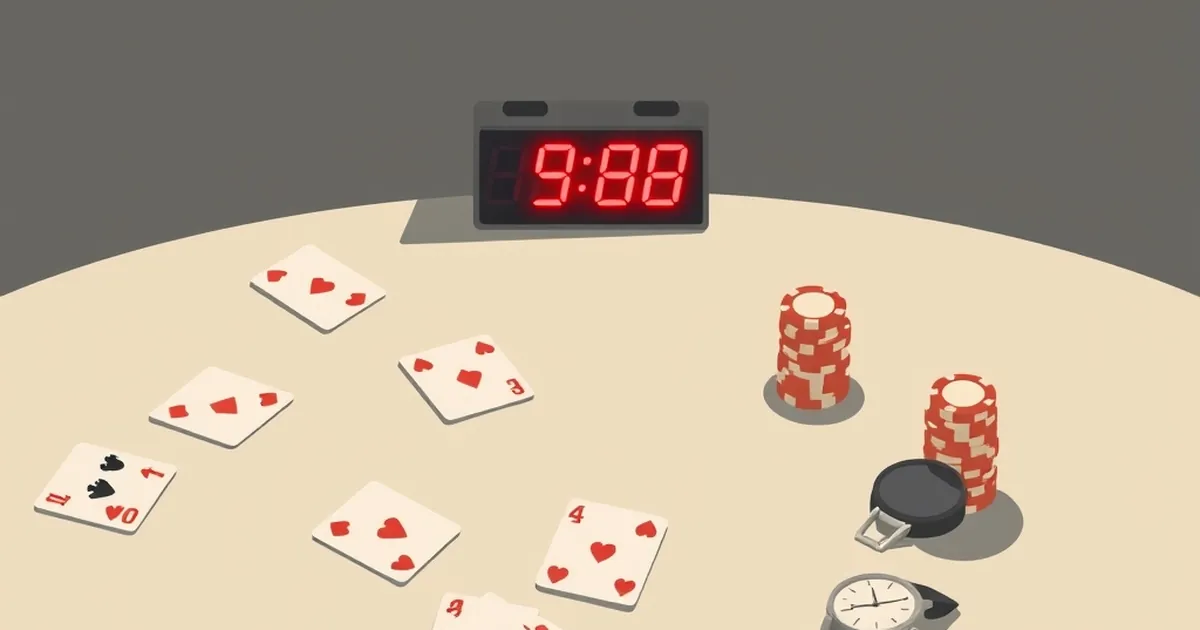
Four minutes before the blinds were scheduled to go up, the clock on the wall said the level had 240 seconds left — and the time bank on Table 7 said zero. That is the specific mechanic the title points at: a player's reserve of extra decision time can be fully spent while the tournament clock is still running, leaving the remaining minutes of the level to be played at the pace of the shot clock alone. It is not a malfunction and it is not a penalty. It is the ordinary arithmetic of a structure that gives players a fixed pool of seconds to draw on and then stops refilling it, and it produces a stretch of play — usually the last level before a blind increase — in which the players with nothing left in reserve are, functionally, playing a different game than everyone else at the table.
The claim is worth taking apart because most coverage of shot clocks and time banks treats them as a single feature: the clock keeps things moving, the bank keeps things fair. In practice they are two separate budgets, and one of them runs out on a schedule the player does not control. When the bank hits zero at T-4:00, what remains is a level whose last four minutes are governed entirely by the per-hand limit, and the players who spent their reserve early are the ones who feel it.
What a time bank actually is, and what it isn't
A time bank is a personal reserve of seconds a player can add to individual decisions. In the live tournament format that popularized the term, each player gets a set number of 30-second cards — often six, sometimes fewer, occasionally more in high rollers — and can play one per decision to extend beyond the base shot clock. Online, the same idea is implemented as a pool of extra seconds that a player activates per hand, with the pool refilling on a fixed schedule: per level, per hour, or per blind period, depending on the operator.
The distinction that matters is between the base clock (the time every player gets on every decision, no questions asked) and the reserve (the time a player chooses to spend). The base clock is a right. The reserve is a resource, and like any resource it can be mismanaged, depleted, and — critically — not restored before the next blind level.
Most structures refill the bank at the start of each level. Some refill on a rolling basis. A smaller number, particularly in turbo and hyper formats, refill on a longer cycle, which means a player who burns the bank in level 6 may enter level 7 with nothing and stay that way for a while. The four-minute window in the title is the tail end of a level in which the bank has already been spent: the player is not out of time in any formal sense, because the level still has minutes on it, but the player is out of their time, which is the only time they can spend on a hard decision.
The shot clock is not the time bank
Confusing the two is the most common error in casual discussion of clocked poker. The shot clock sets a ceiling on every decision. The time bank lets a player exceed that ceiling a limited number of times. A player with no bank left is not slowed down by the clock; they are bounded by it. The difference shows up most clearly in multi-way pots with a short stack involved, where the correct decision often requires estimating a range against two or three opponents and comparing it to pot odds under ICM pressure. That is not a 30-second computation for most people. It is a 60-to-90-second computation, and the bank is where those extra 30 to 60 seconds come from.
When the bank is empty, the player either makes the decision faster than they should or they time out and their hand is folded or checked behind by the client. Online, a timeout is usually a fold; in some clients it is a check if checking is legal. Either way, the player has surrendered the decision to the software, and the software does not know what they were holding.
The four-minute math
The title's four minutes are not arbitrary. They fall out of a standard live structure: 30-minute levels, a 30-second base clock, and six 30-second time-bank cards. A player who uses a card on each of the six toughest decisions in a level will exhaust the bank roughly two-thirds of the way through that level if the decisions are evenly spaced — and in practice they cluster, because the hard decisions in a tournament tend to arrive together, in the same orbit, when the stack-to-pot ratios get awkward and the short stacks start shoving.
Consider a player who reaches the last level before the money bubble with a 25-big-blind stack. The bubble is where the clock matters most, because the correct play depends on the payout structure, the stack sizes of the players to their left, and how close the field is to the money. That is exactly the kind of decision that eats time-bank cards. A player who spends four cards in the first 20 minutes of the level has two left for the final ten, and if a confrontation develops in the last four minutes — a shove, a tank, a decision for most of the stack — they may have one or none.
The numbers behind the structure are not standardized across operators. A survey of published tournament structures in the U.S.-facing market turns up base clocks ranging from 15 to 45 seconds, time banks of 30 to 120 seconds per card or per pool, and refill cycles from "every level" to "every two hours." The 2023 World Series of Poker main event used a 30-second shot clock with six 30-second time-bank cards in the portions of the series that were clocked; other events on the schedule used different configurations. The point is not that any one structure is wrong. The point is that the refill cycle is the variable that determines whether the four-minute window exists at all, and it is the variable players are least likely to check before they sit down.
Why the last four minutes are different
The final minutes of a level before a blind increase are structurally distinct for three reasons, and each one raises the cost of an empty bank.
- The blinds are about to change. A decision made at T-4:00 is a decision made at the current blind level, and the same hand played four minutes later is played at a higher one. Players with a marginal stack have an incentive to act before the increase, which compresses decisions into a shorter window and makes the shot clock bite harder.
- The short stacks are under pressure. Players approaching a blind increase with fewer than 15 big blinds are looking for a spot, and their shoving ranges widen in the last minutes of a level. That widens the range of decisions the bigger stacks have to make against them.
- The bank is at its lowest. Whatever the refill cycle, the end of a level is when the reserve is most likely to be depleted, because the level's worth of decisions has already been made.
Put those together and the four minutes before a blind increase are the four minutes in which the average player is most likely to need extra time and least likely to have it.
The online version is worse, and quieter
In a live room, an empty time bank is visible. The player who tanks and then calls the clock on themselves, or who gets a clock called on them by a neighbor, is making a public admission that they are out of reserve. The table adjusts. The dealer knows. There is social information in the depletion.
Online, none of that is visible. A player whose time bank is empty looks exactly like a player whose time bank is full, because the client does not display opponents' reserves. The only signal is behavioral: a player who suddenly starts acting faster on hard decisions, or who times out in a spot where a timeout is costly, is revealing that they have nothing left. Sharp opponents notice. Most do not, which means the information stays private and the disadvantage stays hidden.
The bigger online problem is the refill schedule. Most U.S.-facing operators refill the time bank at the start of each blind level, which is the fairest arrangement and the one that makes the four-minute window shortest. A smaller number refill on a rolling timer — every 60 minutes, say — which decouples the reserve from the blind structure entirely. A player who joins a tournament at 7:40 p.m. and whose bank refills at 8:00 p.m. has a different reserve schedule than a player who joined at 7:00 p.m., even though they are in the same tournament at the same blinds. That is a fairness question, not a pace-of-play question, and it rarely gets discussed.
There is also the timeout penalty. Some clients auto-fold on timeout; others auto-check; a few impose a small penalty, such as sitting the player out for one hand, after repeated timeouts. The penalty structure changes the optimal strategy for a depleted player: if a timeout costs a hand, the depleted player should fold marginal hands earlier rather than risk timing out on a decision they were going to fold anyway. That is a small edge, but it is an edge that accrues to players who know the client's timeout rules, and it is invisible in any hand history.
Who the empty bank actually hurts
The intuitive answer is that an empty time bank hurts the player who is out of time, and that is true but incomplete. The empty bank redistributes edge in three directions, and only one of them is obvious.
It hurts the player who thinks slowly. This is the direct cost. Some players genuinely need 60 seconds to work through a river decision, and the shot clock does not care. The bank is a compensating mechanism for cognitive style, and depleting it penalizes a legitimate approach to the game.
It helps the player who thinks quickly and knows it. A fast thinker with a full bank is dangerous; a fast thinker facing an opponent with an empty bank is more dangerous, because they can apply pressure in the last minutes of a level knowing that the opponent's decision time is capped. A well-timed overbet in the final orbit before a blind increase is more effective against a player who cannot tank.
It hurts the table's weaker players disproportionately. Strong players manage their bank. They spend cards on decisions that matter and let trivial decisions run on the base clock. Weak players spend cards on marginal spots — a thin call on the turn, a close preflop decision — and arrive at the level's end with nothing for the decision that actually determines their tournament. The time bank, in other words, is a bankroll-management problem in miniature, and the players who are worst at bankroll management are also worst at time-bank management.
There is a fourth effect that is harder to measure: the empty bank changes the texture of the last four minutes. A table where two players are out of reserve plays faster, and a faster table generates more hands per level, which means the blinds come around more often relative to the number of hands played. The structure says the level lasts 30 minutes. The empty bank makes it feel like 26.
What players can do, and what the structures should do
For players, the practical advice is unglamorous: check the refill cycle before you register, and treat the bank as a budget rather than an emergency fund. The most common mistake is spending a card on a decision that a competent player would make in 10 seconds — a preflop fold to a 3-bet, a standard continuation bet — because the card feels free. It is not free. It is a unit of decision time, and the units are finite within a level. A player who spends two cards on routine spots in the first 10 minutes has two fewer for the bubble.
The second practical point is to know the timeout rule. If the client auto-folds, a depleted player should be more willing to fold marginal hands before the clock runs out, because the cost of timing out is the same as the cost of folding but arrives with less information. If the client auto-checks, the calculus changes, because a check is sometimes the correct play and a timeout is sometimes a free check.
For operators and tournament directors, the structural question is whether the bank should refill on the blind cycle at all. Refilling at the start of each level is the cleanest arrangement, because it ties the reserve to the thing that creates the need for it. Refilling on a rolling timer is simpler to implement and harder to explain. Refilling continuously — a few seconds per hand, capped at a maximum — is the arrangement that best matches the underlying problem, because it spreads the reserve across the level instead of front-loading it, and it eliminates the four-minute window entirely. A handful of operators have experimented with continuous refill; it has not become standard, in part because it is harder to market as a feature.
The other structural question is disclosure. If a player's time bank is a resource, opponents arguably have a right to know its state, the same way they know a player's stack. Live poker makes depletion semi-public through the clock-calling ritual. Online poker makes it entirely private. A client that displayed opponents' remaining time-bank seconds — or even a simple indicator that a player was below half — would change the information environment of the endgame level considerably, and it is not obvious that the change would be for the better.
The open question
The four-minute window is a small thing, and it is easy to dismiss as a rules curiosity. But it sits at the intersection of two trends that are reshaping tournament poker: the spread of shot clocks as a pace-of-play measure, and the growth of online tournament schedules that run around the clock and refill resources on timers that have nothing to do with the blinds. The shot clock solved a real problem — slow play — by imposing a cost on deliberation. The time bank was supposed to make that cost bearable. When the bank runs dry four minutes before the blinds go up, the cost lands on exactly the players the bank was designed to protect, and the structure that was supposed to be fair produces a stretch of play that is not.
Whether that is a bug or a feature depends on what the clock is for. If the purpose is pace of play, an empty bank is working as intended: the table moves faster, the level finishes on time, the schedule holds. If the purpose is to give every player a fair chance to make the right decision, an empty bank is a failure of design, because it converts a decision into a reflex at the moment the decision matters most. The operators have mostly chosen the first answer without saying so. The players have mostly not noticed. The four minutes keep coming around, every level, on every table, and the only people who see them clearly are the ones with nothing left to spend.