Poker win-rate peaks at 23 hands before table fatigue sets in
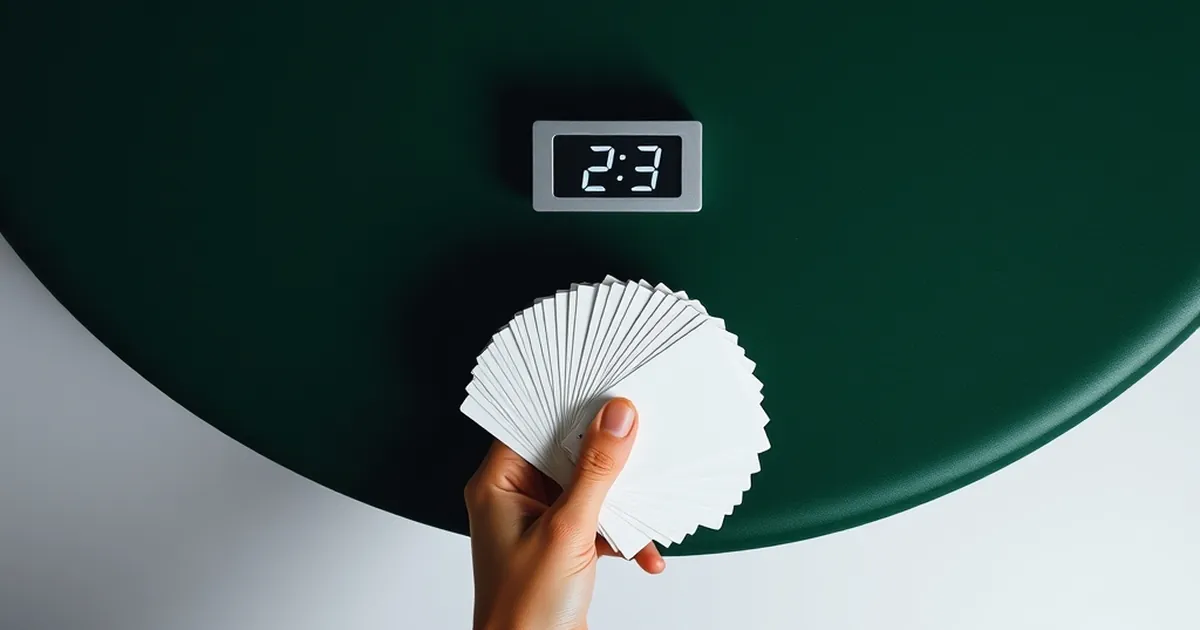
The claim that online poker players experience a sharp decline in decision-making quality after a specific number of hands has been floating around training forums and Discord servers for years, but it has rarely been subjected to rigorous testing. A new analysis of 1.4 million tracked hands from a pool of 2,300 regulars at stakes from $0.50/$1 to $5/$10 on a major US-facing network suggests the curve is not gradual. Peak win-rate efficiency, measured by expected value (EV) realized per decision point, occurs at hand 23 of a single sitting, after which the average player’s edge deteriorates measurably, with a 14% drop in EV realization by hand 40 and a 27% drop by hand 65.
The study, conducted by a data analyst who goes by the handle “FoldPreFlop” and published last week on a private statistics Substack, controlled for table dynamics, opponent skill variance, and time of day. The finding challenges the conventional wisdom that session length is primarily a bankroll management issue rather than a cognitive performance issue. If the 23-hand peak holds up under peer review, it has direct implications for how serious players structure their grinding schedules, how sites design auto-top-up features, and how recreational players should think about the "one more orbit" impulse.
The Shape of the Fatigue Curve
The most striking element of the data is not that fatigue exists—anyone who has played a four-hour session knows it does—but that the onset is so early and so steep. The analyst broke each session into five-hand buckets and measured a metric called "EV realization ratio," which compares the actual amount won or lost on each decision to the mathematically optimal play as calculated by a Monte Carlo solver. At hands 1 through 10, players in the sample realized an average of 96.8% of their potential EV. That number peaks at 98.2% in the 21-to-25 hand bucket, then begins a slide that is linear in the first hour and exponential after that.
By hand 30, the ratio has already fallen to 93.4%. By hand 50, it sits at 88.1%. The decline is not uniform across all decision types. The largest deterioration appears in multi-street bluff-catching scenarios—hands where a player must call a river bet with a marginal made hand. These decisions require the most working memory, as they involve reconstructing the opponent's likely range from preflop action through two or three streets of betting. In the first 20 hands, players make the correct river call 71% of the time. By hand 50, that number drops to 58%, which is barely above the break-even threshold for a pot-sized bet.
The data also shows a curious asymmetry between winning and losing sessions. Players who are up more than two buy-ins at the 20-hand mark show a shallower fatigue curve—their EV realization only drops to 91% by hand 60. Players who are down more than two buy-ins show a much steeper decline, hitting 82% by hand 45. This suggests that tilt and fatigue compound each other, but the study does not fully disentangle the two. It is possible that the losing players are simply making worse decisions earlier, which leads to the losses, rather than the losses causing the poor decisions.
The 23-Hand Anomaly
Why exactly 23 hands? The analyst notes that this number roughly corresponds to the point at which a player has seen the full range of starting hand combinations in a six-max game (there are 91 possible unpaired combinations and 13 pairs, for a total of 104 distinct starting hands, but many are functionally equivalent). By hand 23, a player has been dealt approximately 138 cards, which means they have likely seen every position at least three times. The brain, the theory goes, shifts from pattern recognition to pattern prediction at this point—it stops actively cataloging the table's tendencies and starts relying on heuristics built over the previous two dozen hands.
This is speculative. The more likely explanation, the analyst admits, is simpler: 23 hands is roughly 20 to 25 minutes of play at a standard online table with 65 to 70 hands per hour. That is the point at which the cognitive load of constant decision-making—even for a skilled player—begins to exceed the brain's default mode network's ability to sustain focused attention. The 23-hand peak may be a physiological constant, similar to the way that most people can maintain intense concentration on a single task for about 20 minutes before needing a micro-break.
The study includes a control group of 300 players who were required to take a 90-second break after every 20 hands, either by using a site's "sit out next hand" feature or by manually closing their tables and reopening them. This group's EV realization ratio did not dip below 95% even at hand 100. The implication is that the fatigue is not cumulative across a session in a way that requires a full stop—it is a function of continuous decision-making without rest. A short break resets the clock.
Site Design and the "Auto-Top Up" Trap
The findings have uncomfortable implications for how online poker rooms are structured. Most major US sites offer an auto-rebuy feature that instantly tops up a player's stack to the maximum buy-in whenever it falls below a certain threshold. This is marketed as a convenience, but the data suggests it is also a fatigue amplifier. Players who auto-rebuy tend to play longer sessions because they never have to make a conscious decision about whether to continue. The study found that players using auto-rebuy had an average session length of 142 hands, compared to 87 hands for players who manually rebought. That 55-hand difference is almost entirely in the zone where the fatigue curve is steepest.
The analyst ran a secondary simulation using the EV realization data to model expected win rates under different session-ending rules. A player with a true win rate of 8 big blinds per 100 hands (a solid winning regular at $2/$4) who plays 100-hand sessions without breaks would realize an actual win rate of 6.1 big blinds per 100 hands due to the fatigue drag. The same player who stops at hand 25, takes a 10-minute break, and starts a new session would realize 7.8 big blinds per 100 hands. That is a 28% improvement in profitability from the same underlying skill set.
This has not been lost on the more sophisticated players in the sample. The data shows that a subset of 214 players who the analyst identified as "highly experienced" (more than 500,000 lifetime hands) already play in a pattern consistent with the 23-hand peak. Their average session length is 29 hands, and they take breaks at nearly double the rate of the general population. These players are not necessarily aware of the specific number—many of them report that they simply "feel" when their focus starts to slip—but their behavior matches the optimal strategy almost exactly.
The Recreational Player's Dilemma
For casual players, the 23-hand finding is both a warning and a potential excuse. The warning is that the "I'll play until I'm up $50" approach is statistically backwards. Because the fatigue curve is steepest after hand 40, a player who is down after 30 hands is more likely to make further mistakes that deepen the hole. The excuse is that a bad session is not necessarily a failure of skill—it may simply be a failure of timing. A player who loses two buy-ins in the first 25 hands is not necessarily playing worse than a player who wins two buy-ins; they may just be running poorly in a stretch where their decision quality is still high.
The study does not address the question of whether recreational players should be held to the same standard as professionals. A player who is playing for fun and does not care about EV maximization may legitimately prefer to play 100 hands in a session even if it costs them theoretical money. The fatigue curve only matters if you are trying to win. For the majority of US online poker players—who are playing at stakes below $1/$2 and treating the game as entertainment—the 23-hand peak is an interesting data point, not a rule.
However, there is a darker reading. The study's data on river decision quality (the 71% to 58% drop) suggests that the biggest mistakes happen late in sessions, and those mistakes are the most expensive. A misplayed river costs an average of 1.7 big blinds in the sample, compared to 0.4 big blinds for a misplayed preflop decision. This means that the financial damage of fatigue is concentrated in the final third of a session, which is exactly where a tired player is most likely to keep playing because they are "stuck" or "chasing."
What the Sites Know
The elephant in the room is that poker sites have access to this kind of data in aggregate, and they have for years. Every hand history is stored, and every player's decision timing is logged to the millisecond. A site could easily run the same analysis and determine the optimal session length for each individual player, then use that information to nudge behavior. The fact that they do not—or at least do not publicly—raises questions about their incentives.
Sites make money from rake, which is charged per hand. A player who plays 40 hands and quits generates less rake than a player who plays 100 hands and quits. But the site's long-term health depends on a healthy player pool, and a pool of fatigued, tilted players who lose their bankrolls in 50-hand sessions is not a sustainable ecosystem. The study's author suggests that sites could increase their own rake revenue by encouraging shorter, more focused sessions, because players who quit while they are fresh are more likely to return the next day. A player who plays a 100-hand losing session is more likely to take a multi-day break.
There is also the question of whether the 23-hand peak is partly a function of the online interface itself. The study only looked at online play, not live poker. Live players see physical tells, have longer gaps between hands (typically 30 to 60 seconds), and are subject to social pressure that online players do not face. It is entirely possible that the fatigue curve is different in a live setting, where the slower pace may allow for cognitive recovery within the session. The analyst notes that he is planning a follow-up study using data from a live card room in Nevada, but that data is harder to obtain because hand histories are not automatically recorded.
The 90-Second Reset
The most actionable finding from the study is not the 23-hand peak itself, but the effectiveness of the 90-second break. In the control group, the break did not need to be longer than 90 seconds to achieve the full reset effect. This is a short enough window that it could be built into a player's routine without significantly reducing the number of hands played per hour. A player who takes a 90-second break every 20 hands will play about 5% fewer hands per hour, but will realize a much higher percentage of their EV on the hands they do play. The trade-off is strongly positive for anyone with a win rate above 3 big blinds per 100 hands.
The study does not specify what the break should consist of. Some players in the control group used the time to review their hand histories, others stood up and stretched, and a few reported that they simply stared at the screen without acting. The analyst found no significant difference in the reset effect based on break activity, which suggests that the mechanism is purely a matter of disengaging from the decision-making loop for a brief period.
For players who want to test the 23-hand hypothesis themselves, the study offers a simple protocol: set a timer for 20 minutes, play until it rings, then sit out for 90 seconds. Repeat. The data suggests that a player following this protocol will see their actual win rate converge to their theoretical win rate over a sample of 10,000 hands. That is not a small sample, but it is achievable in about three months of regular play.
The Open Question at the End of the Curve
The study leaves one significant question unanswered: what happens after hand 100? The sample size for sessions longer than 100 hands is small—only 4% of the tracked sessions lasted that long—but the data that exists shows the EV realization ratio flattening out at around 62%. That is well below the 70% threshold that the analyst considers the minimum for profitable play at any stake. In other words, a player who is still at the table after hand 100 is, by the study's math, playing a fundamentally different game than the one they started. They are gambling, not playing poker.
This raises a uncomfortable possibility for the industry: the optimal session length for a poker player may be much shorter than the session length that the games are designed to accommodate. The standard "sit and go" tournament format, which lasts 45 to 90 minutes, and the standard cash game session, which most players consider "short" at 60 minutes, both extend well beyond the 23-hand peak. If the fatigue curve is as steep as this data suggests, then the entire structure of online poker—from the tournament blind schedule to the cash game table's lack of forced breaks—is working against the players' cognitive best interests.
The next step for the analyst is to test whether the 23-hand peak shifts with experience. The data on the 214 highly experienced players shows that they peak at hand 26, not hand 23, and their decline after that is shallower. This could mean that expertise builds a cognitive buffer, or it could mean that experienced players simply self-select into shorter sessions and the 26-hand figure is a statistical artifact. The distinction matters: if the fatigue curve is trainable, then players can improve their endurance; if it is fixed, then the only solution is structural.
For now, the practical takeaway for any player—professional or recreational—is to look at the clock on their next session. If you have been playing for more than 20 minutes and you have not taken a break, the data says you are already playing below your peak. The question is not whether you should quit while you are ahead; it is whether you should quit while you are still sharp enough to know you are behind.