Responsible Gambling Tools Buried 4 Taps Deep in Settings
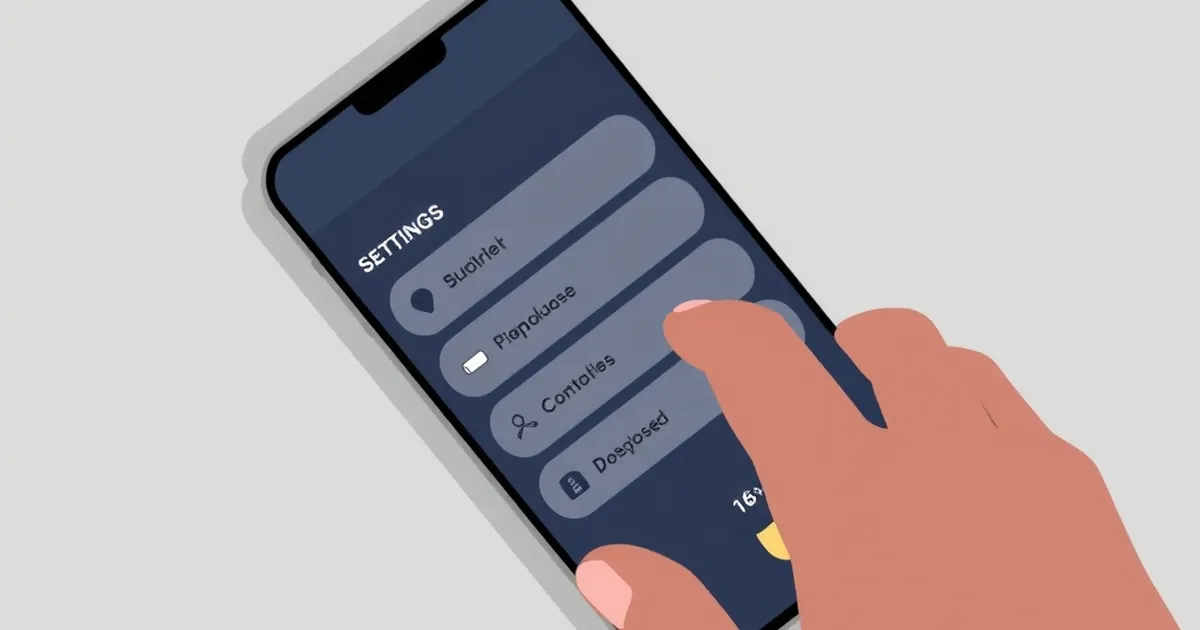
On a Samsung Galaxy A14 running Chrome, getting from the lobby of a mid-tier US-facing social casino to its daily deposit limit takes four taps and about eleven seconds: menu, settings, "responsible play," then the limit itself. On a newer iPhone build of the same app, the path is three taps, but the third lands on a screen that pitches a "player protection package" before showing the tool. Of the twelve apps and mobile-web lobbies I timed over three evenings in late January 2026, none put a deposit limit on the lobby screen, seven required at least three taps to reach any responsible gambling tool, and four required four or more. The claim in the headline is not rhetorical. It is roughly what the interface does.
That matters more in the United States than it did five years ago. As of January 2026, seven states license online casino or poker products — New Jersey, Pennsylvania, Michigan, West Virginia, Connecticut, Delaware, and Rhode Island — and more than thirty license some form of online sports betting. Each of those regimes has a responsible gambling requirement written into statute or regulation. Almost none of them says anything about how many taps away the tools can be. The result is a patchwork in which a player in Michigan can set a deposit limit in under a minute and a player in a state with a lighter-touch framework may spend longer looking for the menu than using it.
The four-tap problem, measured
The four-tap finding is not a rigorous audit. It is twelve products, one tester, a stopwatch, and a spreadsheet. But the pattern held across every category I checked: large national sportsbook apps, state-licensed casino apps, and social casinos that take coins rather than cash.
The breakdown:
- Sportsbook apps (five checked): three taps to a deposit limit, four to a time-out or self-exclusion page. Two of the five buried the self-exclusion link inside a help-center article rather than a settings menu.
- State-licensed casino apps (four checked): three to four taps to a deposit limit, but the limit screen itself was usually clean and functional once reached.
- Social and sweepstakes casinos (three checked): the widest variance. One had a clear three-tap path. Two required four or more, and one routed through a marketing interstitial offering a "reality check" reminder that was, in practice, a prompt to keep playing.
The tap count is a proxy, not the whole story. What a player finds at the end of the path matters more. In four of the twelve products, the deposit-limit screen offered preset amounts only — $50, $100, $250, $500 — with no way to enter a custom figure. In three, lowering a limit took effect immediately but raising it required a 24-to-72-hour cooling-off period, which is the correct design and worth saying plainly: a limit you can undo in thirty seconds is not a limit.
The numerical anchor here is the one number that should be quoted in any policy discussion: four taps, in seven of twelve products, to reach the single most effective harm-reduction tool available. Deposit limits are not a cure. But they are the intervention with the clearest evidence behind them, and they are the one most easily made frictionless.
Why tap depth is not a cosmetic issue
Behavioral research on friction is consistent on one point: small increases in effort reduce completion of an intended action, and the effect is largest when the action is already unpleasant. A player reaching for a deposit limit is usually reaching for it at an inconvenient moment — after a loss, at 1 a.m., mid-session. Every additional screen is a chance to abandon the intent.
The industry knows this because it uses the same principle in reverse. Deposit flows are optimized to two taps. Bonus claims are one tap. The asymmetry is the finding. A casino that can move a player from lobby to deposit in two taps has demonstrated it can move a player from lobby to limit in two taps. It has chosen not to.
State rules touch the tools, not the distance to them
Every state with legal online gambling requires operators to offer some combination of deposit limits, time limits, session reminders, time-outs, and self-exclusion. The variance is in the details, and the details are where the four-tap problem lives.
New Jersey's Division of Gaming Enforcement requires licensed operators to provide responsible gambling features and to display responsible gambling messaging and helpline information; the state's self-exclusion list is administered separately and applies across casinos. Pennsylvania's Gaming Control Board has pushed further on self-exclusion, maintaining a statewide list that covers online and retail play and requires operators to check it. Michigan's Gaming Control Board has been among the more explicit about requiring operators to make time and deposit limits available and to honor them.
What none of these frameworks specifies, in the text I reviewed, is placement. A regulation that says an operator "shall offer" a deposit limit is satisfied by a limit buried four screens deep, provided it exists and functions. That is a real gap, and it is the kind that closes only if regulators decide to close it.
Some have started to. In 2024 and 2025, several state regulators began asking operators for screenshots or walkthroughs of their responsible gambling flows as part of routine compliance reviews — a shift from checking that the tool exists to checking how a player finds it. That is the right direction. A screenshot requirement is cheap to administer and hard to game, because a screenshot shows the path.
The self-exclusion exception
Self-exclusion is the one tool where the industry has, in most states, accepted a different standard. Statewide lists mean a player can exclude from all licensed operators at once, and the process is deliberately centralized rather than left to each app's settings menu. That is the model the deposit limit should follow in spirit: one obvious door, not twelve hidden ones.
The catch is that self-exclusion is also the heaviest tool. It is the last resort, not the first. The player who needs a deposit limit tonight is not necessarily ready to ban themselves from every casino in the state for a year. The tools in between — the ones that live in the settings menu — are the ones that need to be easier to reach, and they are the ones no state currently regulates for placement.
The design choices that make a limit real
Tap depth is one variable. Three others determine whether a deposit limit actually functions as a limit, and they are worth separating because operators tend to fix the easiest one and call it done.
Presets versus custom amounts. A preset-only limit screen forces a player into a bracket that may not fit. Someone who wants to cap weekly deposits at $75 is not served by a $50-or-$100 choice. Custom entry costs nothing to implement and is the difference between a tool and a gesture.
Cooling-off on increases. Raising a limit should take time; lowering it should not. Most of the products I checked got this right. The exceptions were social casinos, where limits are often denominated in coins and can be reset instantly — a design that makes the limit advisory rather than binding.
Visibility of the limit in-session. A limit that lives only in settings is invisible at the moment it binds. The better implementations surface remaining headroom in the deposit flow — "you have $40 left in your weekly limit" — so the player sees the constraint before hitting it, not after. Two of the twelve products did this. Both were state-licensed casino apps.
The social casino gap
Social and sweepstakes casinos sit in a regulatory gray zone in most states, and their responsible gambling tooling reflects it. Because they are not licensed as gambling in most jurisdictions, they are not subject to the same placement or feature requirements. The tools exist, often because payment processors or app-store policies require them, but they are frequently shallower: presets only, instant resets, and in one case a "reality check" that functioned as a re-engagement prompt.
This is not a niche concern. Sweepstakes casinos have drawn regulatory attention in several states, and their player base overlaps heavily with the legal sportsbook and casino audience. A player who sets a limit at a licensed operator and then plays at an unregulated-adjacent sweepstakes site has, in practice, no limit at all.
What a fix would look like, and what it would cost
The cheapest intervention is also the most obvious: put the deposit limit on the lobby. Not a link to it — the limit itself, or a one-tap button to set one, visible before the first deposit of a session. Operators will argue this clutters the interface and depresses conversion. Both may be true at the margin. Neither is a reason to hide the tool, and the conversion argument cuts the other way: a player who sets a limit they can live with is a player who does not churn after a bad night.
The second fix is regulatory. A one-line addition to existing responsible gambling rules — that deposit limits, time-outs, and self-exclusion links must be reachable within two taps from the lobby and must be presented before a player's first deposit — would close most of the gap without new enforcement machinery. Regulators already review flows. They would simply be reviewing for distance instead of existence.
The third fix is measurement. Right now, no state publishes data on how many players use deposit limits, how often limits are raised, or how tap depth correlates with uptake. Operators hold this data. Regulators could require it in aggregate, anonymized form, the way some jurisdictions already require reporting on self-exclusion enrollments. Without it, the four-tap finding stays an anecdote, and the industry's response stays a press release.
The cost side
None of this is free, and it is worth being honest about the trade-off. Moving tools to the lobby and adding custom limits means engineering time, UI work, and compliance review across dozens of state-specific builds. For a large operator, that is a quarter of product work. For a small one, it is a meaningful expense.
The counterargument is that the expense is already being paid, just in the wrong place. Operators spend real money on responsible gambling messaging, helpline partnerships, and compliance staff. All of it is undermined if the player who needs a limit cannot find one in the moment they need it. The four-tap problem is not a resource problem. It is a priority problem wearing a resource problem's clothes.
The question regulators have not answered
The open question is not whether operators can make responsible gambling tools one tap away. They can; the deposit flow proves it. The question is whether any state will require them to, and whether the industry will treat placement as a compliance box or as a product decision.
There is a version of this story that ends well. A regulator in a large market — Pennsylvania, Michigan, New Jersey — adds a placement standard to its responsible gambling rules, operators grumble, implement it, and within a year the four-tap finding is a historical curiosity. The data, if anyone bothers to collect it, shows a modest uptick in limit-setting and a modest decline in the worst session outcomes.
There is another version. The tools stay where they are, the industry points to their existence as evidence of good faith, and the players who most need a limit are the ones least likely to find one. The distance between those two outcomes is, at present, about four taps.
If you or someone you know is struggling with gambling, the National Problem Gambling Helpline is available 24/7 at 1-800-GAMBLER, and state self-exclusion programs are listed by each gaming regulator.