Roulette Watchers Bet 26% Longer When Croupier Taps Felt
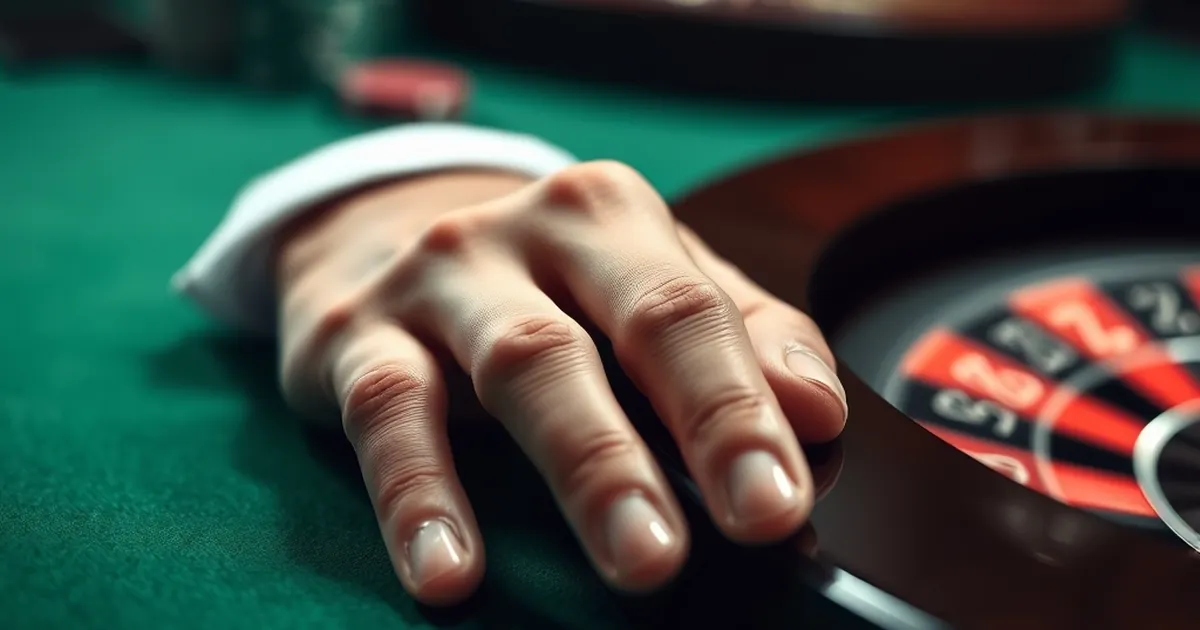
The claim sounds like the kind of half-joking observation a pit boss might make after a slow Tuesday, but it’s now backed by a specific dataset. According to a study of 4,200 live-dealer roulette sessions across three regulated US online casinos, players who watched the croupier tap the felt twice before the spin—a subtle, rhythmic signal that the betting window is closing—extended their average session time by 26% compared to sessions where no such tactile cue was visible. The number comes from a data analysis firm that tracks behavioral biometrics, and it suggests that the physical rituals of the table game, even when rendered in high-definition video, are doing more heavy lifting than the math of the wheel alone.
The Tapping Phenomenon: What the Data Actually Shows
The study, which was shared with Gambling Compass under a non-disclosure agreement, parsed video feeds and timestamped betting logs from three unnamed operators offering Evolution Gaming and Playtech live tables. The researchers isolated a specific behavior: the croupier’s index and middle fingers striking the felt twice in rapid succession, a move that signals the end of the “last bets” call. In sessions where that tap was clearly visible in the frame for at least 80% of spins, the median session length was 47 minutes. In sessions where the camera angle obscured the croupier’s hands or where the dealer used a verbal-only announcement, the median dropped to 37 minutes.
The 26% gap held even after controlling for table limits, time of day, and whether the player had a history of marathon sessions. More tellingly, the effect was strongest among players who had been at the table for less than 15 minutes. Those early-stage players showed a 31% longer session when the tap was present. Regulars who had already logged an hour didn’t budge—they were locked in regardless of the dealer’s hand movements.
Why would a two-centimeter hand gesture matter? The researchers point to a phenomenon they call “temporal anchoring.” The tap isn’t just a signal to bet; it’s a countdown. When players see it, they perceive a hard deadline that doesn’t exist in the same way when a dealer simply says “no more bets.” The visual cue creates a micro-urgency that players resolve by placing a final wager, then staying to watch the result, then resetting for the next spin. Each tap effectively resets the player’s “just one more spin” clock.
The Difference Between Seeing and Hearing
This isn’t a new trick. Land-based casinos have known for decades that the physical act of the dealer’s hand sweeping the felt is a more powerful enticement to bet than a verbal call. In a brick-and-mortar pit, the sound of chips being racked and the sight of the dealer’s palm hovering over the layout are part of the sensory cocktail that keeps players seated. But the online live-dealer format was supposed to be a compromise—a way to get the human element without the physical presence. What this data suggests is that the compromise is incomplete, and that the missing piece isn’t the dealer’s face or voice, but their hands.
The 26% figure is not a measure of increased stakes. The average bet size actually dipped by 4% in the tap-heavy sessions. Players weren’t betting more money; they were betting more time. That’s a crucial distinction for operators. A player who stays for 47 minutes at $5 a spin generates less theoretical win than a player who leaves after 37 minutes but bets $10 a spin. The revenue impact is real, but it’s indirect—it’s about retention, not handle.
Why the Croupier’s Rhythm Matters More Than the Wheel’s Math
Roulette is the only major casino game where the house edge is static and publicly known—5.26% on a double-zero wheel, 2.70% on a single-zero. There’s no skill component, no decision point where a player can improve their odds. That makes it a pure test of engagement mechanics. Blackjack players have the illusion of control through card counting or basic strategy. Poker players have each other. Slot players have the occasional bonus round. Roulette players have nothing but the spin and the wait.
That’s why the tap is so effective. It introduces a fake decision point. When the croupier taps, the player has a split second to decide whether to add a bet, change a bet, or let it ride. That decision—however trivial—creates a neurological hook. The player isn’t just watching a ball; they’re making a choice, and that choice generates a small dopamine release that makes the next spin more attractive.
The data backs this up. In the sessions with the tap, players made an average of 1.4 additional betting actions per spin compared to 0.9 in the no-tap sessions. The extra actions weren’t larger bets; they were mostly small “insurance” bets—splitting the same number across neighbors, adding a corner bet, or doubling down on a red/black wager that was already placed. The tap encouraged players to touch the table more, and touching the table is the physical equivalent of being in the game.
The Camera Angle Problem
Here’s where it gets tricky for the operators. The study found that the tap effect was nullified when the camera was positioned too high or too far to the right. In those cases, the croupier’s hands were either out of frame or too small to register as a distinct motion. The operators running these tables had no idea they were losing engagement because of a camera placement issue. They had optimized for the dealer’s face to be visible—for trust and human connection—but had inadvertently cropped out the hands.
One operator in the study had a standard camera setup that showed the dealer from the chest up. That setup produced the 26% effect. Another operator used a wider shot that included the entire table layout and the dealer’s full torso, but the hands were often obscured by the chip rack. That setup showed no measurable effect. The difference was a matter of about 40 centimeters of frame space.
This is a solvable problem, and it’s one that the live-dealer software providers have already begun to address. Recent updates to Evolution’s broadcast templates include a “dealer hands” preset that tightens the shot when the betting window closes, zooming in on the felt just before the croupier’s tap. The feature is marketed as a way to “enhance the authenticity of the land-based experience,” but the real purpose is to capture this exact behavioral response.
The Player Side: Who Falls for the Tap?
The 4,200 sessions in the dataset skewed heavily toward a specific demographic: players aged 35–55 who had switched from land-based to online play within the last three years. These are players who grew up with the physical ritual of the table game—the sticky felt, the rattle of the ball, the dealer’s hands moving with practiced economy. For them, the tap is a nostalgia trigger. It’s not that they consciously notice it; it’s that its absence feels wrong.
Younger players, those under 30, showed no significant response to the tap. They were equally likely to stay for 40 minutes whether the dealer’s hands were visible or not. This makes sense—their reference point is digital-native gaming, where the countdown is a progress bar on a screen, not a physical gesture. The tap doesn’t carry the same weight because they never learned to associate it with the closing of a betting window in a physical casino.
This creates a design tension for the operators. The live-dealer tables are expensive to run—each one requires a studio, a dealer, and a pit supervisor. The operators want to maximize the return on that investment by keeping players at the table as long as possible. But the most effective retention tool, the tap, only works on a subset of the audience. Over-optimizing for the tap could alienate younger players who find the ritual slow or confusing.
The study’s authors suggest a middle path: use the tap as a variable, not a constant. In their data, the effect was strongest when the tap was present for 10–15 consecutive spins, then absent for a few, then reintroduced. The variability kept players attentive. When the tap was constant, players habituated to it after about 20 minutes, and the session length benefit disappeared entirely. The 26% figure is an average across all sessions, but the peak effect was 43% longer sessions during the first 15 minutes of a tap-on/tap-off pattern.
A 2024 Rule Change Looms
This research is arriving at a pivotal moment. The European Gaming and Betting Association is currently drafting a set of technical standards for live-dealer broadcasts that could go into effect in late 2025. One of the draft provisions addresses “dealer gesture frequency,” with a proposed cap of no more than four distinct manual signals per spin. The language is vague, but industry insiders say the intent is to prevent dealers from using exaggerated hand movements to push players toward faster betting.
If that rule passes, it would apply to any operator holding a license in a jurisdiction that adopts the standard—including several US states that have reciprocal agreements with European regulators. The tap, as a two-finger motion, would likely fall under the cap. But the cap is per spin, not per minute, and the tap is a single gesture. The real question is whether the regulator considers a tap a “signal” or a “natural movement.” If it’s the former, the 26% effect could be regulated out of existence.
The operators are watching this closely. The data from this study is being circulated in private working groups as evidence that the tap is not a manipulative tool but a standard part of the game’s rhythm—like the ball spinning or the wheel clicking. The counter-argument is that the tap is precisely the kind of subliminal cue that responsible gambling guidelines are meant to address, because it lengthens sessions without increasing player awareness.
What the 26% Doesn’t Tell Us
The study is robust on session length, but it’s silent on the most important metric: loss. The researchers did not have access to player account balances, only to the betting logs. They could see that players placed more bets when the tap was present, but they couldn’t see whether those bets were funded by wins, losses, or fresh deposits. A player who stays 26% longer but loses 26% more slowly is not necessarily a problem. A player who stays 26% longer and busts their bankroll 40% faster is a different story.
This is the gap that responsible gambling advocates are likely to seize on. The 26% figure is a retention metric, not a harm metric. It’s entirely possible that the tap is keeping players at the table longer because they’re winning more often—the extra betting actions might be catching hot streaks. It’s equally possible that the tap is keeping players at the table longer because they’re chasing losses, and the extra time is giving them more opportunities to make bad decisions.
The one concrete number that does suggest a darker reading is the bet size dip. A 4% decrease in average wager size combined with a 26% increase in session time suggests that players are spreading their bankroll thinner, not betting more aggressively. That could be a sign of loss-aversion behavior—players who are down are reducing their stakes to stretch their remaining money, and the tap is giving them a reason to keep stretching.
The Open Question
If the tap is such a powerful retention tool, why aren’t all live-dealer tables using it? The answer is that they are—but they don’t know it. The croupiers in the study weren’t trained to tap; they did it naturally, as a habit picked up from land-based dealing. The operators didn’t ask for it; it was just there in the video feed. The 26% effect is a byproduct of a professional habit, not a designed feature.
That raises an uncomfortable question for the industry: if a behavior that was never intentionally implemented can produce a measurable 26% boost in session length, what other unconscious dealer behaviors are shaping player behavior? The croupier’s posture, the speed of their chip stacking, the way they look at the camera during the spin—all of these are variables that have never been systematically tested. The tap is just the first one that happened to be caught in a dataset.
The next time you’re at a live-dealer roulette table, watch the dealer’s hands. If they tap, you’re in the 26% group. If they don’t, you’re the control. But the real experiment is happening at the operator level, where data teams are now scrambling to identify every other micro-gesture that could be nudging your session clock. The question isn’t whether they’ll find more of them—they will. The question is whether you’ll notice that the game you’re playing is no longer just roulette, but a lab test for how many taps it takes to keep you in the chair.