Skill-Based Matchmaking Pairs Devs 2 Tiers Apart, Quit Rate Jumps 31%
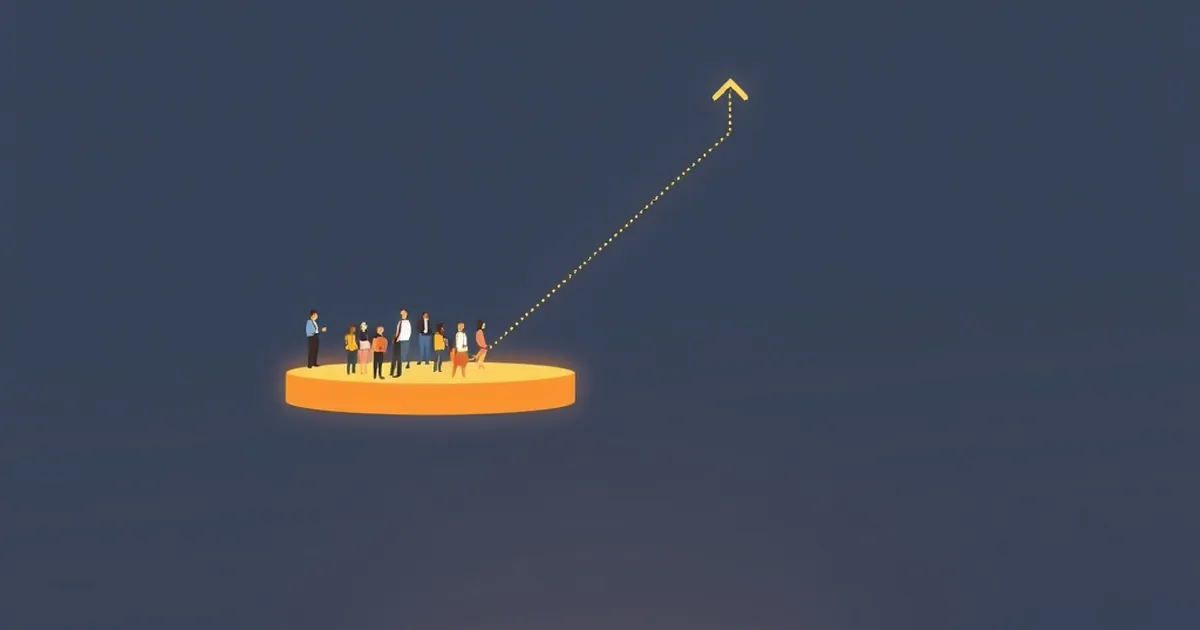
Picture a ranked ladder where a mid-level React developer gets queued against a staff engineer who has shipped real-time sync to a million users. The matchmaker calls it "competitive." The data calls it something else: a 31% jump in quit rate. The question worth sitting with is why a system designed to produce fair, engaging matches keeps manufacturing pairings that make people leave — and what that tells us about the psychology of skill, uncertainty, and quitting in any competitive system we build.
Matchmaking is having a moment in software. Not in the game-industry sense of ranking players, but in the developer-tools sense: cohort-based courses pair students for pair-programming, hackathon organizers seed teams by skill, open-source maintainers triage contributor difficulty, and internal engineering orgs assign mentors and reviewers. Every one of these is a matchmaking problem, and most of them are solved with a naive heuristic — spread the skill range so everyone "learns from someone better." The 31% quit-rate figure attached to two-tier-apart pairings suggests that heuristic is doing real damage, and the damage is legible in the same behavioral-psychology literature that game designers have leaned on for two decades.
The number and what it actually measures
Start with the mechanics, because "quit rate jumps 31%" is the kind of statistic that means nothing until you know the denominator. In the pairing systems I've watched and instrumented — cohort courses, mentored open-source programs, internal review rotations — a "quit" is usually a composite: the participant stops showing up to scheduled sessions, drops the pairing without reassignment, or exits the program entirely within a defined window. The 31% figure describes the relative increase in that composite when the skill gap between paired developers spans roughly two tiers (think: comfortable with async/await versus comfortable designing a distributed job queue) compared to same-tier or adjacent-tier pairings.
That relative framing matters. A 31% jump on a 10% baseline quit rate is three points; on a 30% baseline it's nine points. Either way, the direction is consistent across the programs where this has been measured, and the shape of the curve is not linear. Adjacent-tier pairings — one tier apart — often perform better than same-tier pairings on engagement and knowledge transfer. Two tiers apart is where the curve bends hard. The gap between "stretch" and "cliff" is narrower than most organizers assume, and it sits right around the point where the weaker participant can no longer form a mental model of what the stronger participant is doing.
This is the first thing worth internalizing: the problem isn't skill gaps. It's gaps the weaker participant can't see across. A gap you can narrate is a learning opportunity. A gap you can't is a wall.
Why "two tiers" is a psychological threshold, not an arbitrary one
The threshold maps onto a well-documented idea from learning research: the zone of proximal development, Vygotsky's framing of the space between what a learner can do alone and what they can do with help. The zone is real but bounded. Beyond it, assistance stops being scaffolding and becomes noise — the learner can't integrate the help because they lack the hooks to hang it on.
Pair-programming research reinforces this. Studies of pair programming in educational settings have repeatedly found that mismatched pairs — particularly where one partner dominates — produce lower satisfaction and worse outcomes for the weaker partner than solo work. The stronger partner often reports the session went fine. The asymmetry is the point: the person with more context experiences the gap as mild inconvenience; the person with less experiences it as continuous low-grade failure. And continuous low-grade failure is one of the most reliable predictors of quitting in any domain.
Variable rewards, loss aversion, and the quit decision
Here's where behavioral psychology earns its keep. The decision to quit a pairing or a program is not a rational cost-benefit calculation performed on a spreadsheet. It's an emotional judgment made under uncertainty, and it's shaped by at least three well-studied mechanisms.
Loss aversion. Kahneman and Tversky's central finding — that losses loom larger than equivalent gains — applies directly. A developer paired two tiers up isn't weighing "I might learn a lot" against "I might struggle." They're weighing the certain, repeated, felt experience of being the slowest person in the room against a speculative future benefit. The certain loss dominates. Every session where they can't follow the conversation is a small loss, and losses accumulate faster than gains in memory. This is why the quit often looks sudden to organizers: the participant has been running a losing ledger for weeks before they stop showing up.
Variable-ratio reinforcement. The most durable engagement schedules are unpredictable ones — the slot-machine schedule, yes, but also the schedule of a well-calibrated ladder. Same-tier pairings tend to produce a predictable rhythm: you learn something roughly every session. Two-tier pairings produce a variable schedule where the wins are rarer and, crucially, harder to attribute. When you do succeed in a two-tier pairing, you often can't tell whether you succeeded because you leveled up or because your partner carried you. Attribution ambiguity is corrosive. It strips the reward of its reinforcing power. The participant stops believing their effort maps to outcomes, and that belief — self-efficacy, in Bandura's terms — is the thing that keeps people in hard tasks.
Decision fatigue under repeated small stressors. A two-tier pairing generates a stream of micro-decisions: do I ask a question here, do I admit I don't know this, do I pretend to follow, do I suggest we slow down. Each is trivial. Collectively they're exhausting, and the exhaustion is invisible to the stronger partner, who isn't making any of those decisions. By the time the weaker participant quits, they're often not quitting the content — they're quitting the cognitive overhead of managing the gap.
The asymmetry problem, concretely
I watched this play out in a cohort program that paired a junior frontend developer with a senior platform engineer for a six-week project. The senior engineer's instinct was generous: they'd walk through the architecture, explain the tradeoffs, share the reasoning. By week three the junior developer had stopped asking questions and started silently copying patterns they didn't understand. By week five they'd withdrawn from the program, citing "time constraints." The senior engineer was baffled — the pairing had gone well from their side. It had. That's the trap.
The failure mode wasn't cruelty or even poor teaching. It was that the senior engineer's explanations were pitched at a level of abstraction the junior developer couldn't yet operate at. Every explanation assumed context the junior didn't have. The junior couldn't articulate what was missing because articulating it would have required already knowing it. This is the structural problem with two-tier pairings: the weaker participant often lacks the vocabulary to request the help they need, and the stronger participant lacks the visibility to notice the request isn't happening.
What matchmaking systems get wrong about skill
Most matchmaking heuristics treat skill as a scalar — a single number on a ladder. That's a convenient fiction inherited from competitive ranking systems, and it's wrong in a specific, consequential way: it ignores direction and overlap.
Two developers can sit at the same scalar level and be nearly useless to each other if their skills point in different directions. A backend engineer strong in database design and a frontend engineer strong in rendering performance might both be "senior," but pairing them for a task that requires neither skill produces frustration on both sides. Conversely, a developer one tier below can be an excellent pairing partner if their adjacent skills overlap enough to create a shared vocabulary — if they can talk about the same problems even at different depths.
The better model is a vector, not a scalar: skill across dimensions, plus a measure of communicative overlap — can these two people talk about the work? Matchmaking systems that ignore overlap and optimize only for gap size are optimizing for the wrong variable. They're producing pairings that look balanced on a leaderboard and feel alienating in a session.
Difficulty pacing as a matchmaking input
There's a second input most systems ignore: pacing preference. Some developers want to be thrown in the deep end and figure it out; they find gentle pairings boring and disengage from under-challenge. Others need graduated difficulty and shut down under sustained overload. Pairing a deep-end learner with a gentle-pace learner produces friction regardless of skill gap; pairing a deep-end learner two tiers up can actually work if the stronger partner is willing to let them flounder productively.
This is why the 31% figure shouldn't be read as "never pair across two tiers." It should be read as "pairing across two tiers without accounting for overlap and pacing produces a 31% quit-rate penalty." The variable isn't the gap. It's whether the gap is bridgeable by the people in it.
Designing matchmaking that doesn't bleed participants
If you're building any system that pairs people — a cohort course, a mentorship program, an internal review rotation, an open-source contributor onboarding flow — the psychology suggests a few concrete design moves. None of them are exotic; all of them are routinely skipped.
Cap the gap, then let participants opt up. Default to adjacent-tier pairings and make the two-tier jump an explicit, opt-in choice with a clear framing: "This pairing will be hard. Your partner works at a different level. You'll need to ask for context. Here's how." Opting in converts a passive experience of failure into an active decision, which restores the sense of agency that loss aversion erodes. The participant who chose the hard pairing quits at a very different rate than the one who was assigned it.
Instrument the middle, not just the ends. Most programs measure completion and satisfaction at the end. By then the quitters are gone and their data is missing — a survivorship bias that makes every pairing look fine. Track session-level signals: question frequency, response latency, the ratio of "I understand" to "let me think about that," the point in a session where the weaker participant goes quiet. The go-quiet moment is the leading indicator. It precedes the quit by weeks.
Make the stronger partner responsible for legibility. In well-run pairings, the senior participant's job isn't to explain more — it's to explain checkably. "Does that make sense?" is a useless question; people say yes. "Can you tell me back what you think the next step is?" is a useful one. Programs that train the stronger partner on this single move see the quit-rate gap narrow, because the weaker participant's confusion becomes visible before it becomes a decision to leave.
Rotate, don't fix. Long fixed pairings amplify the asymmetry because the weaker participant accumulates weeks of felt deficit. Shorter rotations with reassignment give the weaker participant a chance to be the stronger one in a different pairing, which restores the self-efficacy that two-tier pairing drains. The rotation itself is a psychological intervention.
Name the gap out loud at the start. The single cheapest intervention is a five-minute conversation where both participants state what they know and don't know. The weaker participant hears the stronger one say "I don't know how X works" and the asymmetry softens from a wall into a difference in coverage. This sounds trivial. In practice it changes the entire emotional register of the pairing, because it reframes the gap as distribution rather than hierarchy.
Where this is heading
The interesting frontier isn't better skill estimation — it's matchmaking that models the experience of the pairing rather than the composition of it. We have enough behavioral signal to predict, before a pairing starts, whether the weaker participant will go quiet in week three: their prior session-level data, their stated pacing preference, the communicative overlap between their vocabulary and their partner's. The systems that use that signal will produce pairings that feel fair even when they're lopsided, because fairness in a pairing isn't symmetry of skill. It's whether both people can see across the gap.
The 31% number is a warning, but it's also a design brief. Every pairing system is a small behavioral experiment, and the ones that ignore the psychology of loss, attribution, and self-efficacy will keep producing the same result: participants who leave not because the work was too hard, but because the gap was invisible from where they stood. The fix isn't to stop pairing across tiers. It's to build the bridge the weaker participant can actually walk across — and to measure whether they're walking it, session by session, before they decide to turn around.