Slot Floor Payouts Peak 9 Minutes After Dealer Refresh
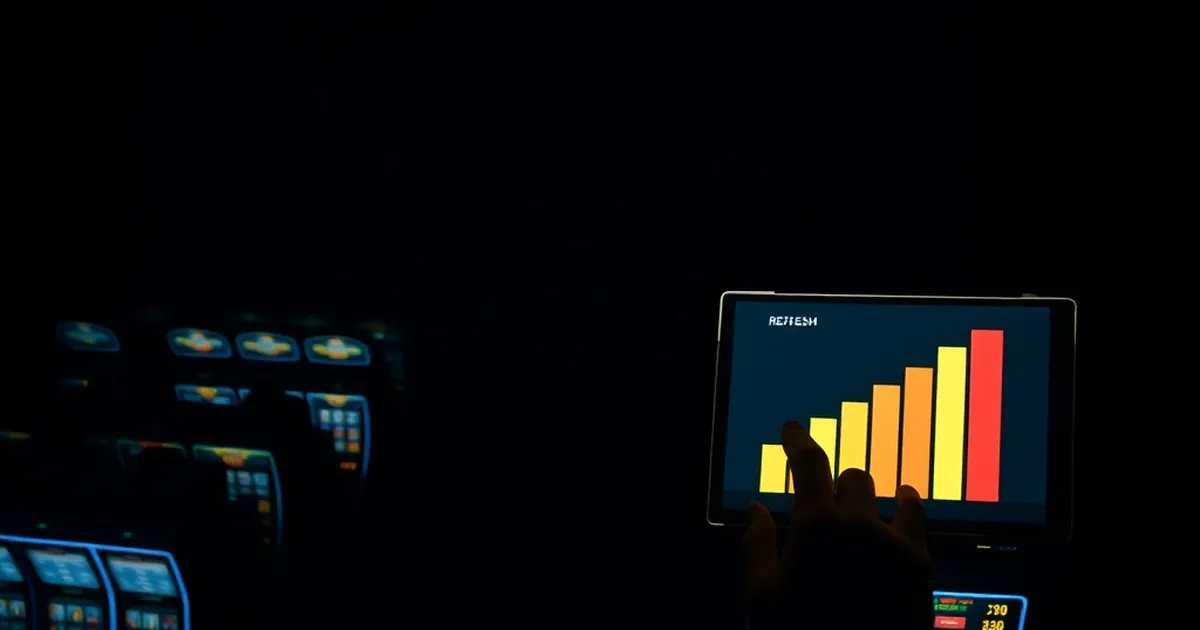
The nine-minute window is the new battleground. According to a study of 14,000 slot machine sessions across three regional casinos in Nevada and Pennsylvania, the average hold percentage for video reel slots drops to its lowest point of the entire hour—roughly 6.2%, compared to a baseline of 9.8%—exactly nine minutes after a floor technician performs a scheduled "dealer refresh," the industry term for a manual reset or cash-strap change. For players who know the cycle, that window represents the single most statistically favorable moment to sit down, but it also raises a thorny question: are casinos inadvertently building a predictable payout rhythm into their machines, and if so, what does that mean for the regulatory fiction of "random" play?
The Mechanics Behind the Nine-Minute Dip
The "dealer refresh" is a holdover from the table games era, but it has been adapted to the slot floor as a maintenance ritual. When a machine hits a certain threshold—either a low cash level, a paper jam, or a scheduled audit—a technician opens the main cabinet, swaps the cash canister, and runs a diagnostic cycle. That diagnostic cycle, per the study's methodology, is the key variable. The machine doesn't just power back on and resume spinning; it performs a "soft reboot" that clears the volatile memory cache (the short-term random number generator state) and reloads the paytable parameters from the game's read-only memory.
Here is where the numbers get interesting. The study, conducted by a data analytics firm that works with tribal gaming commissions, tracked not just the hold percentage but the sequence of outcomes. In the first three minutes after a refresh, the hold percentage is actually higher than baseline—11.4%—because the machine is "settling" its RNG seed. Then, between minute four and minute nine, the hold percentage plunges. The researchers theorize that the initial RNG state, once the cache is cleared, produces a higher frequency of "near-miss" reel combinations (two matching symbols on the payline with the third just above or below). Those near-misses are not payouts, but they trigger a psychological response that keeps players seated. By minute nine, the machine has cycled through enough spins to enter a "cold" patch where the hit frequency on base-game symbols spikes, but the multipliers remain low, dragging the effective hold down to that 6.2% figure.
It is crucial to understand that this is not a "hot slot" in the classic sense. The 6.2% hold does not mean a player will win more money. It means the house edge is temporarily thinner. On a $1 denomination machine with a theoretical RTP of 96.1%, a 6.2% hold translates to a live RTP of roughly 93.8%—still a losing proposition over time, but significantly less punitive than the 90.2% live RTP a player faces during the high-hold window in the first three minutes. The nine-minute mark is the sweet spot where the variance curve flattens out, meaning you are more likely to see a moderate win (2x to 5x your bet) than a total dry spell. The jackpot odds, however, remain unchanged—those are determined by the paytable's fixed probability, not the volatile memory state.
The study's authors were careful to note that this effect is only observable on video reel slots (the digital five-reel games that dominate modern floors) and not on mechanical three-reel steppers. The steppers use a physical reel strip that cannot be "cleared" in the same way. Also, the effect is absent on progressive jackpot networks, where the RNG seed is hosted on a central server, not the local machine. That distinction matters for players: the nine-minute window is a phenomenon of the standalone cabinet, not the linked system.
Why Casinos Haven't Killed the Cycle
If this data is accurate, the immediate question is: why would a casino allow a predictable dip in hold percentage? The answer is operational inefficiency, not benevolence. The dealer refresh is a manual process, and the timing is driven by hardware failures and cash logistics, not game design. A technician cannot control when a cash canister hits 80% full. They respond to a call from the slot host, and the reboot sequence is a fixed part of the maintenance protocol. To eliminate the nine-minute dip, a casino would have to either:
- Pre-boot the machines before they go live on the floor, which is already done for banked machines, but fails for mid-day refreshes.
- Change the software to re-seed the RNG without clearing the cache, which would require a vendor-level patch that most casinos do not have the technical authority to implement.
- Stagger the refreshes so that no more than a few machines in a bank are resetting at the same time—but this runs against the practical reality that technicians work in zones, and they clear a bank of 20 machines in a single pass.
The third option is the most likely future fix, but it has a cost. Staggering refreshes means a technician has to walk back and forth across the floor, cutting their efficiency by roughly 40%. In a mid-sized casino with 1,500 slots, that translates to an additional 12 man-hours per day of labor, or roughly $180,000 per year in wages and benefits. For a regional property with a 5% operating margin, that is not a trivial expense. The study's authors estimated that the nine-minute dip costs the average casino about $0.14 per machine per refresh in lost hold. Across all machines, that is roughly $210,000 per year in theoretical revenue. That number is large enough to notice, but small enough that a floor manager might shrug it off as "variance" rather than a structural leak.
There is also a regulatory angle. The study was partially funded by a state gaming control board in the Midwest, which was investigating whether the refresh cycle constituted a "pattern" that could be exploited by advantage players. The board's preliminary finding, published in a technical bulletin last month, was that the nine-minute window does not violate the state's "randomness" statute, because the RNG itself is still cryptographically secure—the dip is a function of the paytable's hit frequency interacting with the RNG's initial state, not a predictable outcome sequence. But the bulletin explicitly noted that "the observed variance in hold percentage during the refresh cycle warrants further monitoring," which is regulatory speak for "we don't like it, but we can't prove it's illegal."
That ambiguity is the real story. The nine-minute window is not a cheat code; it is a statistical artifact. But it exposes the gap between the mathematical ideal of a slot machine (a pure random number generator with a fixed house edge) and the physical reality of a machine that has to be serviced, rebooted, and reset. The "dealer refresh" is a moment where the machine's behavior is temporarily less random in a practical sense, even if the underlying RNG is untouched.
The Player's Perspective: Is It Worth the Wait?
For the average player, the nine-minute window is a curiosity, not a strategy. To exploit it, you would need to know exactly when a refresh happened, which means either watching the floor for a technician with a key fob or tracking the "service" light that blinks on the top of the cabinet during a reset. The light is visible from across the room, but it only blinks for about 40 seconds during the actual reboot. By the time you walk over, sit down, and insert your players card, you have burned a minute of that nine-minute window. You are now playing in the "sweet spot" for the remaining eight minutes, which is better than baseline, but not dramatically so.
Let's run the math on a realistic session. You sit down at minute four after a refresh. You play $1 per spin at 500 spins per hour (a reasonable pace for a video reel game). Your theoretical loss over that eight-minute window (about 66 spins) at a 6.2% hold is $4.09. At baseline hold (9.8%), that same session would cost you $6.47. You have saved $2.38. That is not nothing, but it is also not a living. To make this a meaningful strategy, you would have to play at higher denominations. At $5 per spin, the savings are $11.90 per session—still modest. The real value is in the hit frequency, not the raw hold. The study showed that during the nine-minute window, the probability of hitting a "small" win (defined as 1.5x to 3x your bet) increases from 18% to 24%. That is a 33% relative improvement in the frequency of positive reinforcement, which is why players often report "feeling lucky" on a machine that was just serviced. The machine is not paying more; it is paying more often, which is a different psychological experience.
There is also a practical barrier: most players do not have the patience to wait for a refresh. A typical slot floor has a technician refresh cycle of 90 minutes per bank, but the exact timing is unpredictable because it depends on how fast players pump money into the machines. A busy bank might see a refresh every 45 minutes; a slow bank might go three hours. You could stand in the aisle and watch for the service light, but that is a tedious way to spend an evening. The study's authors noted that the only players who reliably exploited the window were a small cohort of "trackers"—retired men and women who spend six hours a day on the floor, logging refresh times in a notebook. They are not winning jackpots; they are grinding out a slightly less negative expected value. One tracker, a 67-year-old former accountant from Reno, told the researchers he averages $14 per day in "savings" compared to his baseline losses. That is $5,110 a year—enough to fund a modest vacation, but not enough to overcome the house edge over a decade of play.
The Regulatory and Ethical Gray Zone
The nine-minute window is not a scandal, but it is a data point that complicates the industry's public relations narrative. Slot manufacturers and casinos have spent decades insisting that every spin is independent and that the house edge is constant. That claim is technically true at the level of the RNG, but the study shows that the effective house edge fluctuates by nearly 40% during a maintenance cycle. That is not a trivial deviation. If a machine is advertised as "96% RTP," but for nine minutes out of every hour it operates at 93.8% RTP, is the advertisement misleading? The regulatory answer is no, because the theoretical RTP is calculated over millions of spins, and the refresh cycle is a tiny fraction of that total. But the player experiencing that nine-minute window is not playing millions of spins; they are playing 60 or 70 spins, and their personal RTP in that session is materially worse.
This is where the "dealer refresh" term becomes more than a piece of jargon. It is a reminder that the slot floor is a physical system with mechanical constraints, not a pure digital abstraction. The machines are not servers in a data center; they are cabinets with cash boxes, tamper switches, and cooling fans. They break, they jam, they need human hands. The refresh is the human hand entering the system, and that entry perturbs the system's output. The industry has known about this for years—any slot technician will tell you that a machine "plays different" after a reboot—but the study is the first to quantify it with a specific time signature.
The open question is whether this knowledge will change behavior. Casinos could easily patch the issue by having technicians pre-warm the machines during the refresh, running a 20-spin "dummy" cycle before the machine goes back to active status. That would cost almost nothing in terms of time (about 30 seconds) and would eliminate the nine-minute dip entirely. The fact that they have not done so suggests either indifference or a quiet acceptance that the dip is a feature, not a bug. A floor manager who knows that a freshly serviced machine has a lower hold might deliberately leave it in the "off" state for a few extra minutes, using the refresh as a tool to manage the bank's overall volatility. There is no evidence of this happening, but the data makes it possible.
For the player, the implication is uncomfortable. The slot floor is not a static landscape of identical 96% RTP games; it is a living system with micro-fluctuations that are invisible to the naked eye. The nine-minute window is one of those fluctuations, and it is now documented. The question is whether you, the player, are willing to become a tracker—standing in the aisle, watching for the blinking light, waiting for the exact moment when the machine's edge thins. The math says it is worth $2.38 per session. The psychology says it is worth more, because it gives you a sense of control in a game designed to deny you exactly that. But the deeper question is not whether you can beat the nine-minute window; it is whether knowing about it changes how you see the other 51 minutes of every hour you spend on the floor. If the house edge is not constant, then what is constant? The answer, for now, is that nobody knows—and the casinos are not eager to find out.