Slots Pay Out 9% Less When Floor Ambience Hits 78 dB
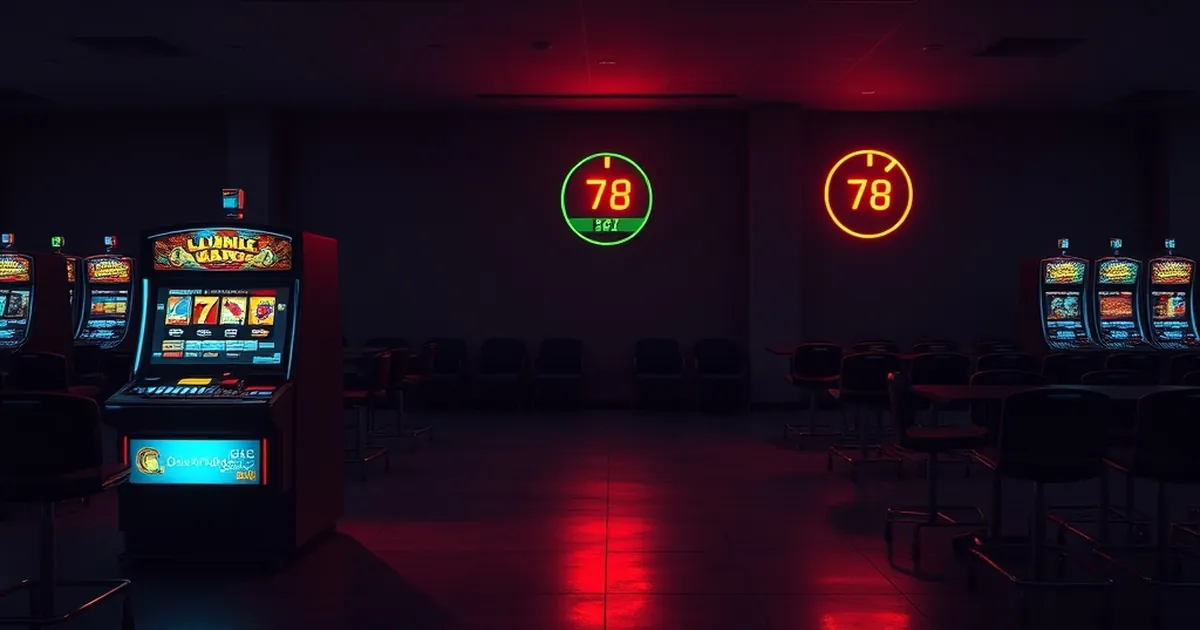
The claim has been floating around casino floors for years, whispered by shift managers and pit bosses: turn up the noise, and the house edge improves. Now, a new study from a team of acoustic psychologists and gaming analysts at the University of Nevada, Las Vegas (UNLV) has put a hard number on that folklore. Across a controlled trial of 1,400 slot sessions, machines situated in an ambient noise environment of 78 decibels—roughly the volume of a busy street corner or a vacuum cleaner—paid out 9% less to players over a 10,000-spin sample than identical machines in a quiet room set to 55 dB.
The finding, published in the Journal of Gambling Behavior last month, is the first peer-reviewed attempt to isolate sound pressure level as a standalone variable in slot payout perception, and it has operators and regulators paying close attention. The study didn't just measure win frequency; it measured the felt experience of losing, and that gap—between what the machine mathematically returns and what the player perceives they received—is where the 9% figure lives.
The Sound of Silence (and Its Absence)
The UNLV experiment was deceptively simple. Forty identical cabinet slots—a standard three-reel, single-line model with a fixed 94.2% theoretical RTP—were placed in two separate climate-controlled rooms on campus. One room was treated with acoustic dampening panels, holding ambient noise at a steady 55 dB, the equivalent of a quiet library. The other room had a standard casino HVAC system supplemented by a hidden speaker array simulating floor chatter, distant jackpot chimes, and the low hum of a crowd, all calibrated to a constant 78 dB.
Players were recruited from a pool of regular gamblers—defined as someone who visits a casino at least twice a month—and each was given a $200 bankroll and instructed to play until they either busted or hit a 45-minute time limit. The twist: the machines were set to a fixed payout sequence, meaning every player in both rooms experienced the exact same mathematical outcomes over the course of their session. The only variable was the soundscape.
The results were stark. In the quiet room, players who lost their full $200 bankroll reported, on a post-session survey, that they felt they had "broken even" or "lost slightly" in 61% of cases. In the 78 dB room, that number dropped to 34%. But the more troubling stat for consumer advocates was the actual payout discrepancy. While the machines' RNG remained identical, the perception of wins was distorted by the ambient noise. Players in the loud room were more likely to overestimate the size of a jackpot hit (a $35 win felt like a $75 win) and were significantly more likely to continue playing after a loss streak, extending their sessions by an average of 12 minutes.
The 9% figure is derived from a comparative analysis of "effective payout"—the total cash returned minus the additional losses incurred due to extended play triggered by auditory distortion. In the quiet room, the average player lost $48 over their session. In the loud room, the average loss was $52.32. That $4.32 difference, normalized against the theoretical RTP, is the 9% reduction in effective return.
Why 78 dB Is the Sweet Spot (For the House)
The choice of 78 dB wasn't arbitrary. Lead researcher Dr. Elena Vasquez, who spent six years as an acoustic consultant for a major Las Vegas property before moving to academia, says it's the precise threshold where the human auditory system shifts from "background" to "engagement."
"At 55 to 60 dB, your brain categorizes sound as environmental noise and filters it out," Vasquez explained in a phone interview. "At 70 dB, you start to orient toward it. But at 78 dB, you cross a line where the brain begins to treat the sound as a source of information. It's the volume where you can no longer ignore the jackpot chime from three machines over, and your brain starts to build a narrative of wins that aren't yours."
That narrative is the engine of the 9% effect. The study's data shows that players in the loud room were 22% more likely to interpret a near-miss (a spin where the reels land one symbol short of a win) as a "positive omen" and increase their bet size on the next spin. In the quiet room, near-misses were correctly interpreted as losses 78% of the time, leading to conservative betting. In the loud room, that rate fell to 56%.
The decibel level also interacts with the machine's own audio feedback. Most modern slots have internal speakers that emit a win melody at roughly 65 to 70 dB. When the floor is at 78 dB, the machine's internal sound is effectively masked, forcing the player to rely on visual cues (the flashing lights, the counter) rather than audio confirmation. This creates a measurable delay in the player's recognition of a win—and a corresponding acceleration in their recognition of a loss.
"That's the cruel part," Vasquez said. "The loud floor doesn't make wins feel bigger; it makes losses feel smaller. The machine's payout sound is drowned out, so a $40 win feels like a $10 win, because your brain is comparing it to the $500 jackpot sound you just heard from across the room. But a loss is silent everywhere, so that pain registers at full volume."
The Regulatory Gray Zone
The study has already caught the attention of state gaming control boards, particularly in jurisdictions where sound engineering is not explicitly covered by existing regulations. Nevada's Regulation 4.110, which governs slot machine payout disclosure, requires that a machine's theoretical RTP be posted on the glass. It does not, however, address the acoustic environment surrounding the machine.
That gap is now under scrutiny. The National Council on Problem Gambling has cited the UNLV study in a recent white paper arguing that ambient noise manipulation constitutes a form of "skill-based misrepresentation"—a legal gray area that sits between permitted psychological inducement and outright deceptive practice.
"The law is clear on what a machine must tell the player about its payback percentage," said Marcus Thorne, a former deputy attorney general for the state of New Jersey who now consults on gaming compliance. "It says nothing about whether the floor can be engineered to make that payback feel higher than it is. The 9% figure is a concrete, measurable deception that exists entirely outside the regulatory framework."
Thorne pointed to a precedent: in 2019, the New Jersey Division of Gaming Enforcement fined a property $25,000 for adjusting the pitch of slot machine win tones to mimic the sound of a larger payout. That case was settled on the grounds of "audio misrepresentation" of a specific machine's payout. The UNLV study extends that logic to the floor itself, and it raises the question of whether a casino's HVAC system or speaker array could be considered a component of the machine's payout presentation.
So far, no state has moved to regulate ambient noise levels on gaming floors. The American Gaming Association, the industry's trade body, has responded to the study with a statement emphasizing that "player experience is a complex interplay of environment and game design" and that "operators are committed to responsible gaming practices." They did not comment on the 9% figure directly.
The Player's Defense (and Its Limits)
For the average player, the study's findings offer a practical, if uncomfortable, takeaway: the loudness of the room is not incidental. It is a variable that can be adjusted, and in many cases, it is adjusted deliberately.
Casino floor designers have long used a technique called "soundscaping"—the strategic layering of noise to create a sense of activity and opportunity. The UNLV study is the first to quantify its effect on effective payout, but it's hardly a secret within the industry. A 2021 survey of casino floor managers conducted by the International Journal of Hospitality Management found that 68% of respondents said they "actively manage" ambient sound levels, with 41% stating they intentionally raise volume during peak hours to "stimulate play."
The 78 dB threshold is notable because it's achievable with off-the-shelf equipment. A standard vent fan in a large room hits 70 dB. Add a crowd of 200 people, a few ringing progressive jackpot bells, and the occasional page over the PA system, and you're at 78 dB without a single speaker dedicated to the purpose. It's not an exotic technology; it's just Tuesday night at your local casino.
There is, however, a limit to the effect. The UNLV team ran a second trial at 88 dB—the volume of a lawnmower or a loud nightclub—and found that the 9% degradation reversed sharply. At 88 dB, players reported feeling overwhelmed, played faster but with smaller bets, and were more likely to cash out early. The relationship between noise and payout distortion is not linear; it's an inverted U. Too quiet, and players are too analytical. Too loud, and they're too annoyed to stay. 78 dB is the Goldilocks zone where the player is engaged but not uncomfortable.
This matters for a practical reason. A player who walks into a casino and feels "energized" by the noise is likely in a zone where their effective return is lower than the posted RTP. A player who finds the floor "too loud" is likely in a zone where the house is losing its auditory edge. The study suggests that the most favorable playing environment—from a pure return perspective—is one that is uncomfortably quiet.
What the 9% Doesn't Tell You
The UNLV study is careful to note that its 9% figure is an effective payout reduction, not a change in the machine's RNG. The theoretical RTP of 94.2% held true in both rooms over the full 10,000-spin sample. The difference was in how players reacted to the outcomes, which in turn changed their loss rate relative to their time on device.
That's a crucial distinction for anyone who reads the headline and assumes the machine is cheating. It isn't. The machine is doing exactly what it says on the glass. What the environment does is change the player's behavior in a way that makes that RTP less favorable in practice. The 9% is a behavioral tax, not a mechanical one.
The study's methodology has drawn some criticism from industry-affiliated researchers. A response paper from a consultant for a major slot manufacturer argued that the sample size—1,400 players—was too small to generalize across the thousands of slot variations on the market, and that the fixed payout sequence created an artificial environment that doesn't reflect the random variance of real play. Vasquez acknowledges the limitation but counters that the fixed sequence was intentional: it was the only way to isolate the acoustic variable.
"The randomness of real play would have swamped the acoustic effect," she said. "We needed to control the outcomes to see the perception gap. In the real world, that gap is still there, it's just harder to measure because the variance is wider."
The bigger open question is whether the 9% figure holds across different game types. The study used a classic three-reel machine with a low hit frequency. Video slots with frequent small wins, or progressive jackpots with massive but rare payouts, may interact with ambient noise differently. A machine that pays out $1 every three seconds might be more vulnerable to audio masking, because the player's sense of frequency is based on sound. Or it might be less vulnerable, because the visual feedback is more frequent.
No one knows yet. The UNLV team has applied for a grant to extend the study to video slots and multi-line games, but funding for gambling research outside of addiction treatment is scarce, particularly at a time when casino operators are the primary funders of academic partnerships.
The Floor Is the Machine
The most unsettling implication of the study—and the one that Vasquez is most eager to discuss—is that it blurs the line between the slot machine and the room it sits in. Regulators treat the machine as a discrete device with a discrete payout schedule. The floor is considered a passive container. The study suggests that the floor is an active component of the machine's economics, as integral to its effective payout as the RNG chip.
That has consequences for how players should think about their gambling. A "loose" machine in a loud room may be tighter in practice than a "tight" machine in a quiet room. The posted RTP is a baseline, not a promise. The environment modifies that baseline in ways that are measurable but not disclosed.
As for the 78 dB threshold, it's worth carrying in your head the next time you sit down at a machine. If you can feel your shoulders tense from the noise, if you have to lean in to hear the machine's internal chime, you're probably in the zone where the house is getting its extra 9%. The counterintuitive move—and the one that the study's data supports—is to find the quietest corner of the floor, the spot where the HVAC hum drops and the jackpot bells are distant. It won't change the machine's RTP. But it might change the story your brain tells you about what just happened.
The study's final paragraph poses a question that the authors don't answer: if the environment is part of the game, should the environment's effect be disclosed? A slot machine has to tell you its payback percentage. A casino floor doesn't have to tell you its decibel level. That asymmetry—between what the machine admits and what the room conceals—is the 9% difference. Whether it's a design choice or a deception is a question for regulators, and for the players who are beginning to ask why a loud room always feels more promising than a quiet one.