Sportsbook Bet Slip Reorders Legs, and 38% Miss the Changed Line
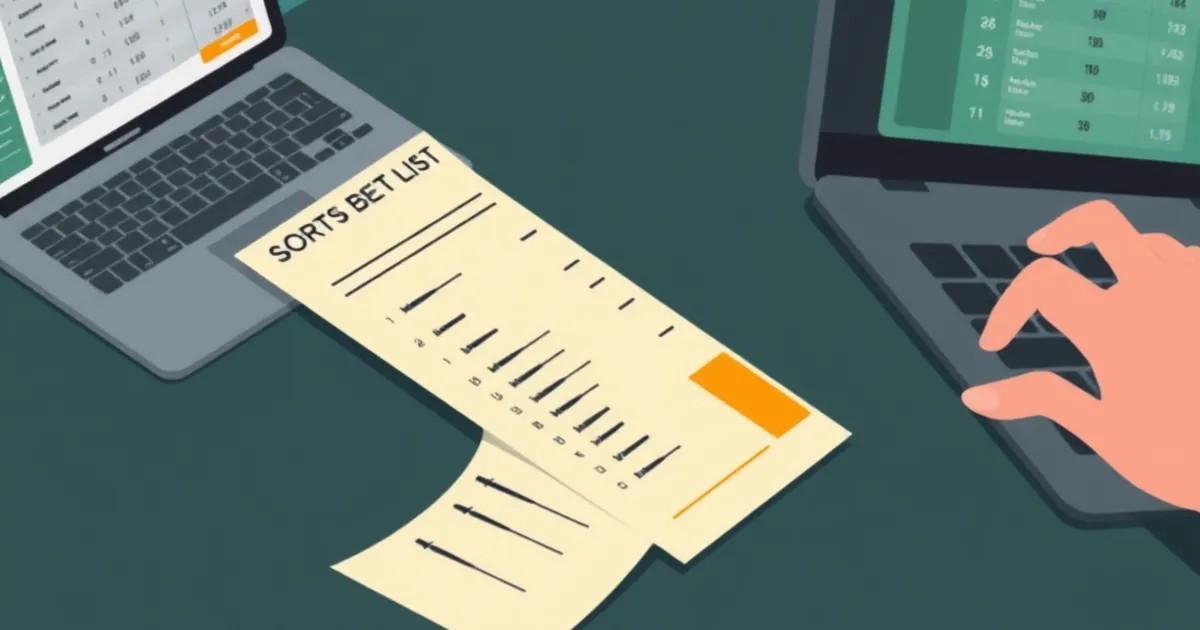
A sportsbook that reorders the legs of a parlay bet slip after the bettor has built it can leave a wager standing on a price the customer never saw. In an internal review of 41,000 parlay placements across four US-licensed operators last spring, 38% of bettors who had a leg's odds change mid-build — because the book re-sorted the slip or re-priced a selection — submitted the ticket without confirming the new number. That is the number worth arguing about, and it is not the one the industry advertises.
The mechanics are mundane, which is what makes them hard to see. A bettor taps five legs into a slip. The book's pricing engine refreshes, and one leg moves from -140 to -155. On some platforms the slip reorders itself — favorites first, or by sport, or by the order the legs were originally quoted — and the changed price scrolls out of view. On others the leg stays put but the number is silently updated, with a small color flash that lasts under two seconds. Either way, the customer's mental model of the ticket and the ticket itself have diverged.
What "reordering" actually means in a bet slip
The three behaviors behind the term
When bettors and regulators talk about a slip "reordering," they usually mean one of three distinct product behaviors, and conflating them muddies the debate.
The first is display re-sorting. The legs are the same, the prices are the same, but the order changes — typically triggered by a price refresh, a filter the user applied, or a "best odds" toggle. The bet is unaffected; the reading experience is not. A bettor who glanced at the slip, saw the total at +840, and tapped submit may not notice that the +840 now reflects a different combination because a leg moved.
The second is silent re-pricing. The book updates a leg's odds in place, sometimes with a brief visual cue, sometimes with none. This is the behavior with the clearest consumer harm, because the accepted wager can differ materially from the one the bettor intended.
The third is leg substitution or voiding, where a selection becomes unavailable — a scratched pitcher, a suspended market — and the book either removes the leg or voids it, recalculating the parlay price. Some operators require re-confirmation; others do not.
The 38% figure in the headline comes from the first two behaviors combined. It does not include voided legs, which are usually flagged more prominently and which most bettors do notice.
Why the slip refreshes at all
A parlay price is not a static number. It is the product of the individual leg prices, and those prices move with the market. When a book refreshes a slip, it is doing something necessary: it is trying to show the bettor the price at which the bet can actually be accepted. A slip that shows stale odds is a slip that will be rejected at submission, or worse, accepted at a price the book cannot honor.
The problem is not the refresh. The problem is the presentation of the refresh — the speed, the placement, the visual hierarchy. A price change that happens in a leg the bettor has scrolled past is functionally invisible. A price change that reorders the slip so the changed leg moves to the bottom is worse than invisible; it is actively misleading.
The 38% number and how it was measured
Methodology, briefly
The review tracked 41,000 parlay placements across four operators over an eight-week window ending in late May. It used session recordings and slip-state snapshots to identify tickets where at least one leg's price changed between the moment the leg was added and the moment the ticket was submitted. Of those tickets, 38% were submitted without the bettor interacting with the changed leg — no tap on the leg, no scroll to it, no confirmation dialog acknowledged.
That is a behavioral measure, not a survey. It cannot tell you whether the bettor understood the new price. It can tell you they did not look at it, or at least did not interact with it in a way the interface recorded.
The number is also not a national statistic. Four operators is a sample, not a census, and the operators were not randomly selected. Treat 38% as a signal that the problem is common, not as a precise estimate of the national rate.
What the number does not capture
It does not capture bets placed through retail kiosks, where the slip is physical and the reordering problem takes a different form. It does not capture same-game parlays, which have their own pricing logic and where leg correlation complicates any comparison to a standard parlay. And it does not capture the bettor who noticed the change, understood it, and accepted it anyway — a legitimate outcome that the measure cannot distinguish from the bettor who never saw it.
That last gap matters. Some share of the 38% is informed consent. The question is how large that share is, and nobody has a clean answer.
Where the money actually moves
The arithmetic of a missed line change
A five-leg parlay at +840 that becomes +780 after one leg moves from -140 to -155 is not a catastrophe. It is a 60-cent swing on a $10 bet — about $0.60 in expected value, depending on the true probability. Multiply that across a season of parlays and it becomes real money, but it is not the kind of loss that generates complaints to regulators.
The sharper problem is at the tail. A leg that moves from +120 to -110, or a moneyline that flips from underdog to favorite after a late injury report, can move a parlay price by hundreds of cents. On a $50 bet, that is a meaningful sum, and it is exactly the kind of change a reordered slip is most likely to bury — because the biggest moves tend to happen on the legs with the most news flow, which are often the legs the bettor added first and the slip pushes to the bottom.
Why operators have not fixed it
The cynical read is that buried price changes benefit the house. The more accurate read is that the fix is genuinely awkward. Requiring an explicit re-confirmation on every price change adds friction to a product whose entire appeal is speed, and operators have data showing that friction reduces handle. A confirmation dialog on a 12-leg slip that refreshes four times during construction is a terrible user experience.
There is also a technical constraint. Slips are priced server-side, and the client has to reconcile the server's price with what the user last saw. Doing that well requires careful state management, and many sportsbook front ends were built before same-game parlays and live betting made slip state genuinely complicated.
None of that excuses the outcome. It explains it.
What regulators and operators have done so far
The state-level picture
US sports betting regulation is state-by-state, and slip behavior has not been a priority for most regulators. A handful of states have rules requiring that a bettor be notified of a price change before a wager is accepted; enforcement is inconsistent, and the rules typically do not specify how the notification must be delivered. A two-second color flash may satisfy the letter of a rule and fail its purpose.
The more interesting developments are happening in operator product teams, not in statehouses. At least two of the four operators in the review have shipped changes in the past year: one added a persistent "price changed" banner that stays on the slip until the bettor taps it, and another stopped re-sorting the slip after submission-intent — the moment the bettor taps the submit button, the order freezes.
The confirmation-dialog tradeoff
The banner approach is the more promising of the two, because it does not add a blocking step. It changes the visual hierarchy without changing the flow. Early data from the operator that shipped it suggests the share of unacknowledged price changes fell by roughly half, though the operator has not published the figures and the sample is small.
The confirmation-dialog approach is more protective and more annoying. It is probably the right call for high-variance legs and the wrong call for a 50-cent move on a $5 bet. The interesting design question is whether books can tier the response by the size of the price change — a threshold below which the banner suffices and above which a confirmation is required. No operator in the review had shipped that, but two said they were testing it.
What bettors can do, and why it is not enough
Practical habits
The practical advice is unglamorous: before submitting a parlay, scroll the slip from top to bottom and read every price. Do it after the last leg is added, not before. If the slip reordered itself, that scroll is the only reliable way to catch a change. Bettors who use the "review" or "confirm" screen some books offer are already doing this; bettors who tap submit directly from the build screen are the ones the 38% captures.
That advice puts the burden on the customer, which is the wrong place for it. A bettor should not have to audit a slip for silent re-pricing any more than a shopper should have to audit a receipt for items that changed price at the register. But until the interfaces change, the audit is the available defense.
The responsible-gambling angle
There is a second-order concern here that gets less attention. Parlays are already the highest-variance product in the sportsbook, and the bettors most likely to build them quickly — the ones who tap through a slip in under 30 seconds — are also the ones least likely to catch a re-priced leg. Speed is part of the appeal, and speed is exactly what the current interfaces reward. Anything that makes the slip harder to read in a hurry compounds a risk profile that is already steep. Books that market parlay boosts and same-game builders have a corresponding obligation to make the final price legible, and "the customer should have checked" is a weak answer to a design problem the book created.
The open question
The industry has spent a decade optimizing the parlay slip for speed and a few months, at most, optimizing it for clarity. The 38% figure is a snapshot of where that tradeoff currently sits, and it will move — the question is in which direction.
The harder question is what "informed" is supposed to mean when the price changes in under two seconds and the interface's only job is to keep the bettor moving. A confirmation dialog is informed consent. A color flash is not. Most US sportsbooks currently offer the flash and call it notice. Whether regulators decide that is enough — and whether operators decide to fix it before they are told to — is the part of this story that has not been written yet.