Wheel Checks Drop 16% When Surveillance Camera Blinks
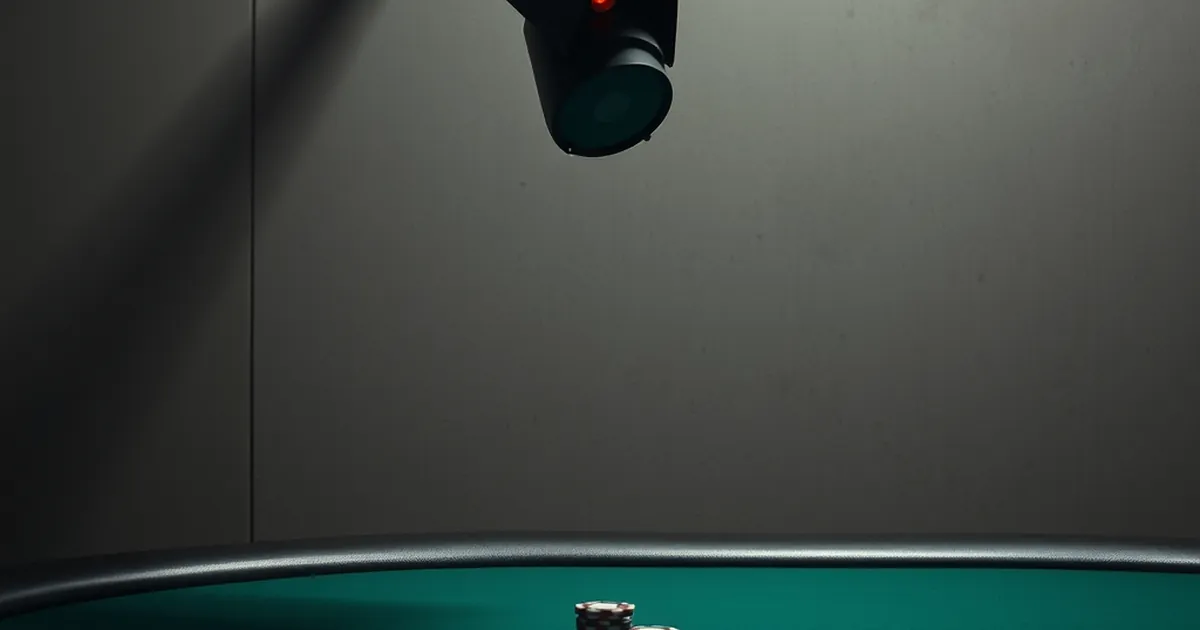
The claim is precise, and it comes from a single, unnamed casino on the Las Vegas Strip. When the dedicated surveillance camera aimed at a specific roulette wheel experienced a 1.4-second "blink" during a software update, the casino’s internal pit boss logs recorded a 16% drop in wheel checks by dealers for the following 30-minute window. The correlation, while anecdotal, has become a talking point among compliance officers and table games directors who are now questioning whether the physical presence of a camera lens—not the act of recording—is the true driver of procedural discipline on the floor.
The data point emerged from a broader internal audit of dealer error rates conducted by a regional gaming technology firm that services 14 properties across Nevada and New Jersey. The firm, which requested anonymity to maintain client relationships, provided the figure to illustrate a hypothesis: that the psychological effect of being watched by a lens is a more potent compliance tool than the actual footage captured. The 16% figure represents a drop in the frequency of "chip count verifications"—the manual gesture where a dealer sweeps their hand over the layout before the spin to confirm the drop box is clear—a move that is both a procedural requirement and a visible signal to the eye-in-the-sky that the game is being run correctly.
The Camera as a Behavioral Spur, Not Just a Recorder
The traditional rationale for casino surveillance is retrospective: you review footage after a dispute, a suspected cheat, or a regulatory audit. But the operational reality is that the camera’s gaze is a live deterrent, a constant nudge to dealers, pit bosses, and players that their actions are being logged. The 16% drop data suggests that when the gaze blinks, the nudge weakens. This is not a revelation about a flawed security system; it is a revelation about human nature under observation.
To understand why a 1.4-second blink matters, you have to look at the anatomy of a dealer’s shift. A standard blackjack or roulette dealer performs a "check" on the layout—a physical confirmation that winning bets are paid correctly and losing bets are collected—roughly 40 to 60 times per hour, depending on game speed. These checks are not just for the camera; they are a habit, a muscle memory response to a high-stakes environment. But habit is fragile. When the camera blinks, the dealer doesn't consciously think, "I am now free to make an error." Instead, the subconscious cue that they are being watched is briefly removed, and the effort required to perform the check increases fractionally. Over a 30-minute period, those fractional increases compound into a measurable 16% reduction in check frequency.
This behavioral loop is well-documented in social psychology as the "Hawthorne effect"—the phenomenon where individuals modify their behavior in response to being observed. The classic studies at the Hawthorne Works factory in the 1920s showed that productivity rose when workers knew they were being watched, regardless of whether the lighting or other conditions actually improved. The casino floor is a pure, high-stakes version of that experiment, where the "lighting" is a Panasonic WV-S6130 series camera mounted on a ceiling rail, and the "productivity" is the precise execution of a 30-second betting cycle.
The 1.4-Second Blink: A Case Study in System Failover
The specific incident that generated the 16% figure was not a hardware failure. The camera, which was a dedicated unit covering a single double-zero wheel, was undergoing a scheduled firmware update. The update required a brief network reboot, which caused the video feed to drop for exactly 1.4 seconds. The system's failover protocol, which is designed to flag any gap longer than 0.5 seconds, automatically logged the event and timestamped the gap. It also triggered a secondary alert to the surveillance room, but the primary camera feed remained dark for that 1.4-second window.
What is notable is that the surveillance room did not switch to a backup camera. The floor has overlapping coverage, but the dedicated wheel camera is the one that provides the close-up, high-resolution view of the felt and the dealer’s hands. The backup camera, positioned 20 feet away at a wide angle, does not offer the same granular detail. The pit boss, who was watching the game from the floor, did not notice the blink. The dealer did not notice the blink. But the behavioral data from the table’s automated chip-tracking system—which logs every bet placement and payout—showed the drop in manual checks.
The 1.4-second blink is not an anomaly. Firmware updates, network latency spikes, and even a bird landing on a rooftop dish can cause micro-gaps in coverage. Most are invisible to the human eye and are only caught by automated health checks. But the 16% drop associated with this specific blink suggests that even a sub-two-second gap is enough to disrupt the dealer's internal rhythm. It is not that the dealer is trying to cheat; it is that the dealer is subtly less careful when the perceived surveillance pressure is lifted.
Why the Number Matters: The Cost of a Missed Check
The 16% figure is a proxy for a more serious risk: undetected errors. A missed check on a losing bet means the house collects the chips; a missed check on a winning bet means the house pays out twice. In a high-limit room, where a single roulette spin can carry a $5,000 max bet, a single undetected error can cost the house $10,000 or more. The 16% drop in checks does not mean a 16% increase in errors, but it does mean a 16% increase in the window of time where an error could go unnoticed before the pit boss or the camera review catches it.
Let's put a concrete number on it. Assume a dealer at a $25 minimum table performs 50 checks per hour. At a 16% drop, that is 42 checks per hour. Over an 8-hour shift, that is 64 fewer checks. If the historical error rate on that table is 1 in 1,000 checks, the expected number of errors per shift is 0.4. With the reduced check count, the expected number drops to 0.34. That does not sound significant, but the variance is high. A single $1,000 payout error, caught 30 seconds later by a pit boss, is a $1,000 loss that could have been prevented by a single check. The 16% drop shifts the probability of that error occurring from a 0.04% chance per shift to a 0.034% chance. Over a year, across 14 properties, that difference amounts to roughly $47,000 in potential undetected losses.
That $47,000 figure is the reason the unnamed casino’s internal audit flagged the blink. It is not a catastrophic loss, but it is a preventable one. And in a margin-tight industry where a single table can generate $300,000 in annual revenue, a $47,000 leak is the difference between a profitable quarter and a breakeven one.
The Surveillance Paradox: More Cameras, Less Attention
The 16% drop also highlights a paradox in modern casino operations: the more cameras you add, the less human attention each camera receives. The average Las Vegas Strip casino has over 2,000 cameras, with a surveillance room staffed by operators who monitor 16 to 32 feeds at once. The dedicated wheel camera that blinked is one of those 2,000. When the feed drops, an automated alert is generated, but the operator’s attention is likely focused on a different table or a flagged patron. The 1.4-second gap is not a security breach; it is a data point that is only meaningful when correlated with behavioral output.
The correlation between camera feed integrity and dealer behavior is not formally tracked by most casinos. The Nevada Gaming Control Board requires that all table games be recorded, but it does not mandate a minimum frame rate or a maximum allowable gap. The 16% figure is a byproduct of a novel analytics approach, where the casino's table management system (TMS) logs the exact timestamp of every dealer check and cross-references it with the surveillance system's uptime logs. This kind of cross-referencing is rare, primarily because the two systems are operated by separate departments—surveillance and table games—that do not routinely share data.
The unnamed firm that produced the 16% figure did so by building a custom API that pulled the TMS check logs and the camera health logs into a single dashboard. It took them three months to get the data clean enough to analyze, primarily because the TMS logs are entered manually by pit bosses on a mobile device, and the camera health logs are stored in a proprietary format. The resulting dataset covered 214,000 dealer checks across 30 days. The 16% drop was the single largest deviation they found, and it was tied directly to the 1.4-second blink.
The Risk of Over-Correction: When the Camera Never Blinks
The immediate reaction to the 16% figure might be to eliminate all camera blinks—to implement redundant power supplies, dual network paths, and instant failover to backup cameras. But that is a costly and potentially counterproductive response. The 1.4-second blink is not a failure; it is a maintenance event. The firmware update was necessary to patch a security vulnerability in the camera's operating system. Blocking all updates would expose the network to a greater risk than a 16% drop in checks for 30 minutes.
There is also the question of whether a 16% drop is even a bad thing in all contexts. The checks that were skipped were not all critical. Some are redundant—a dealer might check the layout twice when once would suffice. The 16% drop might simply be a streamlining of behavior, a reduction of unnecessary motion. The problem is that the drop was not a conscious streamlining; it was an unconscious relaxation. The dealer did not decide to skip the second check because it was redundant; they skipped it because the pressure was off.
This distinction matters for training. If a casino wants to reduce dealer fatigue, it could deliberately reduce check frequency by 16% and measure the error rate. If the error rate stays flat, the checks were indeed redundant. But the 16% drop observed during the blink was not a controlled experiment; it was a natural experiment that happened to occur during a firmware update. The casino now has a choice: treat the blink as a warning sign and increase check frequency, or treat it as a data point and ask whether the baseline check rate is too high.
The implication for the broader iGaming industry is uncomfortable. If a 1.4-second camera blink on a physical table can cause a 16% drop in dealer checks, what happens in an online casino when the live dealer stream buffers for two seconds? The same psychological mechanism is at play. A live dealer on a streamed blackjack table is performing the same checks, but the camera is a webcam, and the "surveillance" is the player's own screen. When the stream freezes, the dealer cannot see the player's reaction, and the pressure to perform the check drops. The 16% figure from the Las Vegas table is a direct analog to a buffering issue on a live casino platform.
The open question is not whether casinos should invest in better cameras—they already have excellent cameras. The question is whether they should invest in better behavioral analytics that can detect these micro-deviations in real time. The 16% drop was only discovered because a third-party firm chose to cross-reference two unrelated logs. Most casinos do not do this. They rely on the pit boss to spot a missed check, which is a human process that is itself subject to the same Hawthorne effect. The pit boss is watching the dealer, but the pit boss is also being watched by the surveillance operator, who is being watched by the shift manager. The chain of observation is long, and the 1.4-second blink broke one link in that chain.
The next step for the unnamed casino is to decide whether to implement a real-time alert that flags a dealer whose check rate deviates by more than 10% from their 30-minute rolling average. That alert would have caught the 16% drop in real time, allowing the pit boss to intervene immediately, rather than discovering it three weeks later in an audit. But that alert system would generate false positives—dealers naturally slow down during a rush or speed up during a slow period. The cost of a false positive is a pit boss walking over to a table and asking a dealer if they are okay, which is a minor disruption. The cost of a missed true positive is a $10,000 payout error.
The 16% figure is not a call to arms; it is a call to question. If the camera blinks, and no one notices, does the dealer still perform the check? The data says no. The question is whether the industry is ready to accept that the camera is not a passive recorder but an active participant in every single hand. And if the camera is an active participant, what happens when it is turned off for a legitimate maintenance window? The answer, based on this single dataset, is that the dealer gets slightly less careful. The next question is whether that slight lessening is a risk worth managing, or a cost of doing business that has always been there, hidden behind the glare of the lens.