Real-Time Betting Architecture: How a Live Odds Feed Actually Works
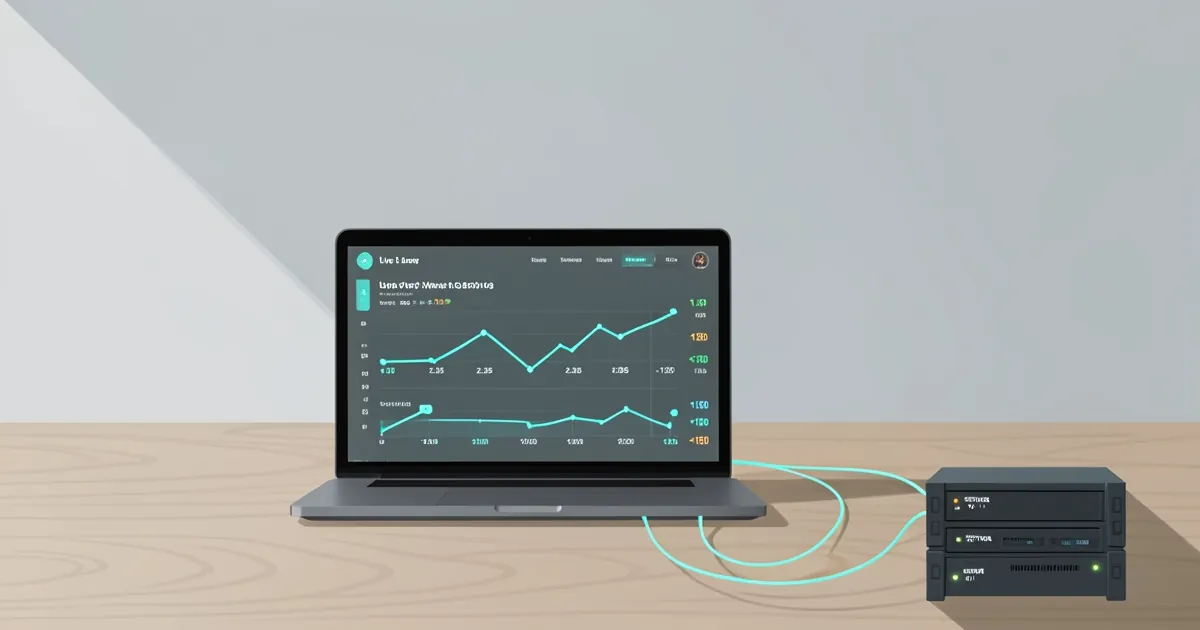
Real-time betting architecture is the chain of systems that turns a stadium event into a repriced number on a bettor's screen in under two seconds: a data scout or official feed at the venue, a normalization layer that maps every provider's vocabulary onto one internal model, an odds engine that recomputes prices and margins, a stream that pushes only the deltas, and a risk service that can suspend a market faster than any of them. The example most engineering teams converge on is a soccer goal: the in-stadium scout taps a button, the price on the pre-match favorite collapses, the over/under line resets, and every open bet slip in the world is re-evaluated — all before the broadcast feed in most living rooms shows the replay. What follows is how that pipeline is actually assembled, where it breaks, and why the hard problems are almost never the ones in the marketing deck.
The feed layer: where the number is born
Every live price traces back to an origin. There are two kinds. The first is official: league and governing-body data distributors that sell low-latency event streams to sportsbooks under contract, often with sub-second delivery over dedicated connections and a contractual obligation to be the settlement source of record. The second is human: scouts in the stands, watching the same match you are, pressing buttons on a handheld terminal. Both end up in the same place, and both introduce the same class of problem — the feed tells you what happened, not what it means for a specific market.
A goal is unambiguous. A shot that may or may not have crossed the line is not. A VAR review in soccer, a challenge flag in American football, a photo finish in horse racing: each creates a window where the raw feed has fired an event but the market outcome is still undecided. Good architecture handles this with an explicit state machine per market — open, suspended, pending_settlement, settled, void — rather than letting the odds engine infer intent from a stream of loosely typed messages.
Latency budgets are set here, not later. If the origin feed arrives 800ms late, no amount of downstream optimization recovers it. Teams typically instrument the feed layer first: timestamp on arrival at the ingest edge, timestamp at normalization, timestamp at price publication. That three-point trace is the single most useful diagnostic in the whole stack, because it tells you whether a slow price is a data problem or a compute problem.
Normalization is the unglamorous core. Provider A calls it match_id, provider B calls it fixtureId, provider C sends a nested object with the competition, season, and round embedded in a string. A mapping service resolves all of them to one internal identifier, and it must fail loudly. Silent mapping failures are how a price ends up on the wrong fixture — the kind of bug that is invisible in staging and catastrophic in production.
The odds engine: pricing in milliseconds, not minutes
Once an event is normalized, the pricing layer decides what the new number should be. Three approaches dominate.
Model-driven pricing computes a probability from a statistical model — an in-play Elo or a Poisson goal model, for instance — and applies a margin. It is fast and consistent but can be wrong in ways the model has never seen, which is why most operators blend it with a trader override.
Trader-driven pricing puts a human in the loop for the markets that matter. The trader sees the event, sees the model's suggestion, and accepts, adjusts, or suspends. This is where the sharpest operators differentiate, and it is also where the architecture gets awkward, because a human decision has to propagate to every client as fast as an automated one.
Hybrid pricing runs the model automatically inside pre-set guardrails and escalates to a trader when the model's output moves beyond a threshold. That threshold is the interesting design parameter: too tight and traders are overwhelmed during a busy Saturday; too loose and the book takes positions it did not intend.
The engine's output is not a single number but a market state: selection prices, available stake limits, and a suspension flag. Publishing all three together matters. A price that updates without its limit is a trap — a bettor sees 2.10 and discovers on submit that the maximum stake is $4. The margin itself is usually applied as a percentage overround across selections, and in-play margins run wider than pre-match because the operator is carrying more risk per second of exposure.
This is also where the front-end and the engine start to disagree. A price can be correct on the server and stale on the client, and the gap is measured in the hundreds of milliseconds it takes a message to traverse the delivery layer. If you have read our breakdown of why live odds widgets freeze on in-play taps, that failure is usually the client rendering path, not the pricing math.
Transport: pushing deltas to a million screens
The delivery layer is where most real-time betting architectures earn or lose their reputation. The default choice is a WebSocket connection per client, with the server publishing only changed selections rather than full market snapshots. A full snapshot of a busy soccer market might be 40KB; a delta for one selection is a few dozen bytes. At scale, that difference is the whole game.
A concrete anchor: a mid-size operator with 200,000 concurrent in-play users, each subscribed to an average of 12 markets, generating a price change somewhere in their subscription set roughly every 1.5 seconds during a peak Saturday, is pushing on the order of 1.6 million delta messages per second at the edge. That number is why the transport layer is usually a fan-out problem, not a WebSocket problem. The pattern is a pub/sub backbone — the odds engine publishes to a topic per competition or per fixture, and edge nodes subscribe and fan out to their connected clients.
Backpressure is the failure mode everyone hits. When a client cannot consume messages as fast as they arrive, a naive server buffers them, memory climbs, and the process eventually stalls or dies. The correct response is to drop intermediate states and keep only the latest price per selection — a bettor does not need the 14 prices a selection passed through in the last two seconds, only the current one. That coalescing logic is the difference between a stream that degrades gracefully and one that falls over. We wrote about the specific way Node.js stream backpressure stalls live feeds past 500 events per second, and the fix there is the same principle: conflate, don't queue.
Two more transport details matter more than they look.
Sequence numbers. Every delta carries a monotonically increasing sequence per market. A client that receives sequence 1,042 after 1,039 knows it missed two updates and must request a snapshot rather than apply a stale price. Without this, a dropped message silently becomes a wrong price on screen.
Clock discipline. Server timestamps and client timestamps drift. The client should render "price updated 400ms ago" from server-supplied times, not its own clock, or the staleness indicator lies.
Risk and the bet-slip race
The risk service sits beside the pricing engine and answers one question per bet: is this stake acceptable at this price, right now? It enforces per-selection limits, per-account limits, exposure caps per market, and the suspension state that the feed layer set. It is also the component that has to win a race against the bettor.
Consider the sequence: a bettor taps submit on a price of 2.10. Between the tap and the risk service's decision, a goal is scored and the market suspends. The correct behavior is to reject the bet and tell the bettor the price changed — not to accept it at 2.10 because the request arrived first. This is why the risk check and the price validation must happen in the same transaction against the same market state, and why "price changed, please review" is a legitimate and necessary response rather than a UX failure.
The race gets harder on mobile. A bet slip that re-renders mid-submission can submit the wrong selection or the wrong stake, and rotation events on phones make this worse. Our piece on mobile rotations killing live bet slips documents how often the slip loses its state, and the architectural lesson is that the submitted payload must be frozen at tap time, not read from live state at send time.
Settlement is the mirror image of pricing. A settled market must publish a result that every downstream system agrees on: the bet history, the wallet, the regulator's reporting feed. This is where a durable log earns its place. High-stakes live betting produces write bursts that can outrun a relational database's write-ahead log, and why a PostgreSQL write-ahead log falls behind during those bursts is a useful case study in why settlement events are usually written to an append-only log first and projected into relational tables second.
What the architecture implies for the people using it
The engineering choices above are not neutral. A 400ms delta push and a 1.5-second snapshot refresh feel identical to an engineer reading a dashboard and completely different to a bettor deciding whether to take a price. When the number on screen is stale, the user has no way to know whether the market moved or the widget failed, and the honest answer is usually "both, a little."
That has a responsible-gambling dimension that operators rarely design for explicitly. Fast-moving prices and suspended markets create a rhythm that encourages rapid re-betting, and a bettor who cannot tell a genuine price move from a rendering artifact is being asked to make decisions on information they cannot verify. A visible, accurate staleness indicator — "updated 0.3s ago" — is a small piece of interface honesty that costs almost nothing to build and does real work. So is refusing to auto-accept a changed price without a confirmation tap, even when the change is in the bettor's favor.
The open question is where the latency floor settles. Official feeds are getting faster, edge compute is getting cheaper, and the gap between the fastest and slowest books is widening rather than closing. At some point the differentiator stops being "who has the lower-latency feed" and becomes "who can prove to a bettor, and to a regulator, that the price they saw was the price they got." That is an audit problem dressed as an infrastructure problem, and very few operators have built the timestamp trail that would let them answer it.